
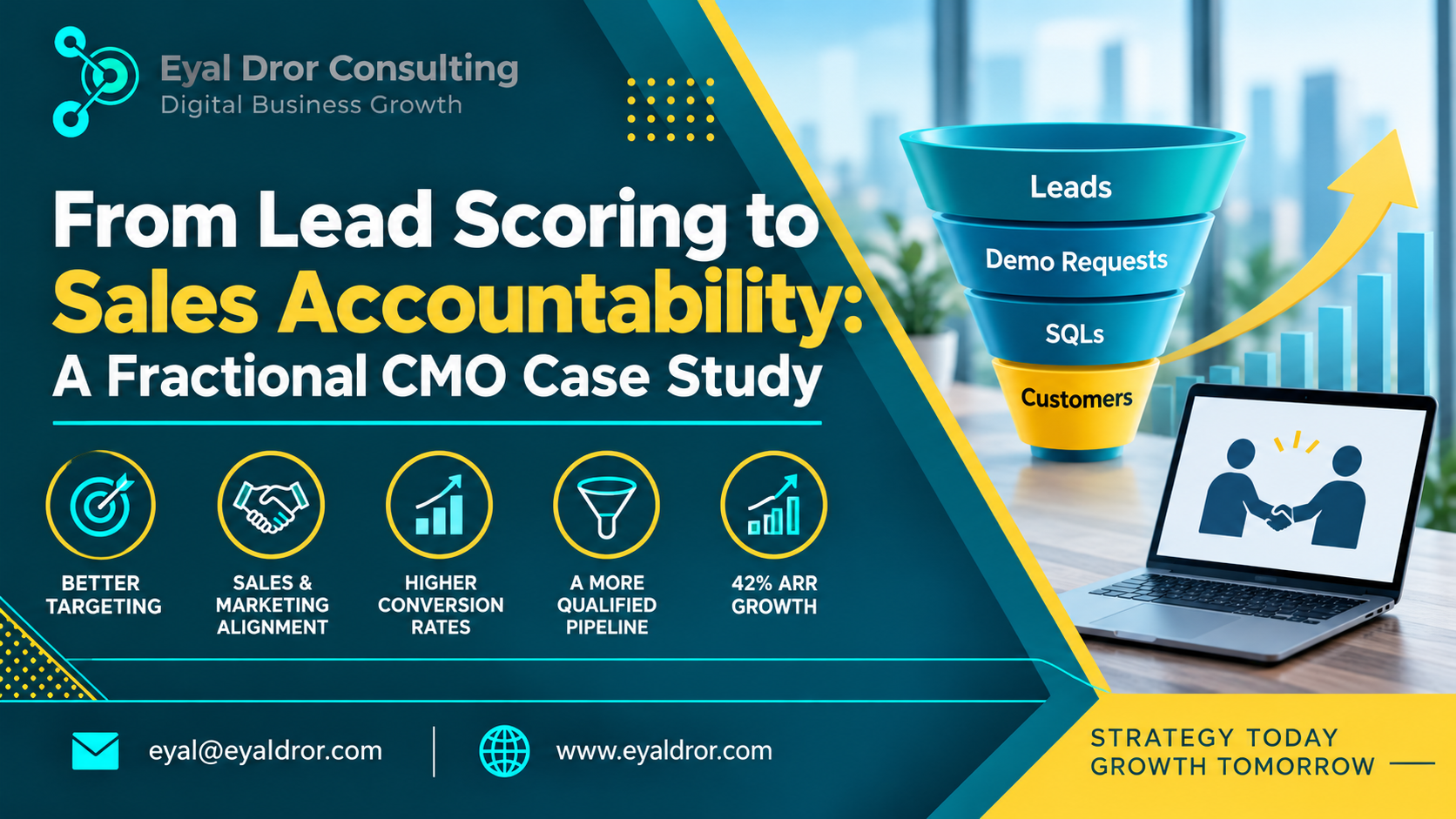
Marketing says the leads are ready. Sales says they are cold. Marketing keeps nurturing, sales goes to conferences to find its own pipeline, and nobody can say which side is right.
That was the situation at an anonymous fintech SaaS company serving small and midsize businesses (SMEs) when Eyal Dror joined as fractional CMO. This fractional CMO case study walks through what was broken, what changed and what the results do and do not prove.
The Engagement at a Glance
| Detail | Summary |
| Client | Anonymous fintech SaaS company serving SMEs |
| Role | Eyal Dror, Fractional CMO |
| Duration | About 18 months, with most changes made in the first six |
| Focus | Marketing and sales alignment, qualification, campaign strategy and funnel accountability |
The Challenge: Marketing Activity Without Sales Progression
The company already had a nurturing process and a lead-scoring system. Neither was producing a dependable flow of sales-qualified opportunities.
Marketing qualified leads (MQLs) included leads generated on the website and cold prospect data. Marketing used engagement signals, such as the number of pages a person viewed, to decide when to hand a lead to sales. Sales had its own standard for a sales-qualified lead (SQL): the prospect had to fit the ideal customer profile (ICP) and show intent to buy within the next three months.
The two definitions never met. Sales had defined the criteria, but the actual handoff ran on engagement scores instead. Marketing passed along the leads it believed were ready. Sales looked at them and considered them cold.
There was also no working feedback loop. Marketing could not learn why leads were rejected, and sales had no obligation to explain. Marketing kept scoring and nurturing. Sales increasingly turned to conferences for lead generation. The disagreement persisted because the process gave nobody the information needed to resolve it.
The Diagnosis: Engagement Was Being Treated as Buying Intent
Eyal’s first step was to review how marketing and sales were synchronized. The central problem became clear quickly. Engagement was being used as a proxy for buying intent, with no shared operating process to test whether that proxy was true.
Someone who reads ten pages of your site may be a student, a competitor or a curious prospect with no budget. Page views show interest. They do not show fit or timing. Making the scoring model more sophisticated would not have fixed that. The mismatch between what marketing counted as ready and what sales required was the actual problem.
The Intervention: Rebuild the Handoff and Close the Feedback Loop
The fix had five parts.
1. Replace Scoring-Based Handoffs With Demo Requests
The nurture-and-score process was cut back. A demo request became the trigger for a direct handoff to sales, who then qualified the prospect against ICP fit and intent to purchase within three months.
This separated an expression of interest from a qualified sales opportunity. A prospect who asks for a demo has taken a deliberate step, which tells you far more than a page-view count does.
2. Make Sales Ownership Explicit
The handoff was defined and automated. Sales became responsible for qualification and for giving visibility into each lead’s status and journey.
That removed the option of quietly ignoring a lead. Marketing now had the information to tell apart four different problems: poor targeting, weak intent, slow follow-up or a bad fit.
3. Turn Weekly Feedback Into Campaign Decisions
Weekly meetings reviewed individual leads and the aggregate patterns behind them. The teams looked at qualification and progression, then connected those outcomes to campaign trends.
Marketing could now adjust campaigns based on the prospects sales actually wanted to pursue, not simply the audiences most likely to click or browse.
4. Change Channels, Targeting and Messaging
Three changes followed from the feedback:
- Channel investment shifted away from Google and toward LinkedIn.
- Targeting was sharpened around the intended buyers.
- Feature-led copy was replaced with messaging about customer pain points.
For CFO audiences, the framing focused on the concerns and responsibilities of the role rather than a list of platform capabilities. The objective was fewer low-quality leads and more relevant opportunities, not maximum lead volume.
5. Feed Downstream Outcomes Back to LinkedIn
Downstream lead data was shared server-to-server with LinkedIn to support campaign optimization. This extended the feedback loop beyond internal meetings and back into acquisition, so the platform could learn from what happened after the form fill.
The Results: A More Selective, Accountable Funnel
Under the revised process, the reported averages were:
| Metric | Outcome |
| Demo-to-SQL conversion | About 70% on average |
| SQL-to-customer conversion | About 25% on average |
| Demo volume | About 10 to 20 new requests per month |
| Lead quality | Fewer low-quality leads and sharper targeting |
These are averages, not isolated peak results. Marketing gained clearer feedback about which campaigns produced suitable buyers. Sales gained a more relevant pipeline and explicit responsibility for progressing it.
During the engagement, the company also reported 42% year-over-year ARR growth.
What These Numbers Do and Do Not Show
Funnel results are easy to overstate, so two points matter.
First, the MQL definition changed during the engagement. The earlier scoring-based process produced effectively no progression from MQL to SQL. The 70% figure applies to demo requests under the revised definition. It is not a like-for-like comparison across an unchanged lead population, so it should not be read as a jump from 0% to 70%.
Second, the 42% ARR growth is company-wide context. It should not be attributed solely to the funnel changes. The outcomes directly tied to this work are the qualification rate, the SQL close rate, improved lead quality and the operating process established between marketing and sales.
The figures are approximate and based on information supplied by Eyal Dror. Underlying CRM and financial records were not independently reviewed.
Lessons for B2B SaaS Teams
The pattern is common, and several lessons carry over to other companies.
Define readiness in sales terms. If sales requires ICP fit and intent within three months, that is what the handoff should test. A score built on engagement alone measures something else.
Use a deliberate action as the trigger. A demo request is a stronger signal than any amount of passive browsing, and it gives sales a clear starting point.
Give sales explicit ownership and require feedback. Marketing cannot improve targeting if rejected leads disappear without explanation.
Review leads together every week. Looking at individual leads and aggregate patterns in the same meeting turns disagreement into campaign decisions.
Optimize for relevant opportunities, not lead volume. Fewer, better leads gave both teams something they could work with.
Close the loop with your ad platforms. Passing downstream outcomes back to the channel helps it find more people like the ones who actually become customers.
The approach can be summed up in one sequence: buyer-focused campaigns, demo request, automated sales handoff, qualification, documented progression, campaign feedback.
Why a Fractional CMO Fit This Problem
This was a leadership problem more than a tactical one. The company did not need more campaigns or a better scoring formula. It needed one senior person who could look across marketing and sales, resolve the mismatch between them and hold both teams accountable for what happened next.
That is the kind of work a fractional CMO does: executive-level strategy and cross-functional leadership without a permanent executive hire. If you are weighing the model, our guide to outsourced CMO services explains how it compares with other options. The funnel and handoff work in this case also overlaps with sales funnel optimization and revenue operations consulting, which focus on the systems connecting marketing, sales and revenue.
Frequently Asked Questions
What did the fractional CMO change first in this case?
The handoff. Scoring-based handoffs were replaced with demo requests, which triggered direct sales qualification against ICP fit and three-month purchase intent.
Did the 70% result come from improving the old scoring model?
No. The earlier process produced effectively no MQL-to-SQL progression, and the MQL definition changed. The 70% applies to demo requests under the revised process, so it is not a like-for-like comparison.
Can the 42% ARR growth be credited to the funnel changes?
Not entirely. It is company-wide growth reported during the engagement and gives commercial context. The directly tied outcomes are the qualification rate, the SQL close rate, improved lead quality and the new operating process.
Is Your Marketing and Sales Handoff Working?
If marketing and sales disagree about lead quality, the cause is often a definition and accountability gap rather than a lack of effort. A conversation can show whether senior leadership is what is missing.
