
Why I’m Writing This
I see the same pattern every few weeks. A founder Google’s “outsourced CMO services,” reads three or four articles that all describe the same fuzzy concept, senior marketing leadership, part-time, flexible, and none of them explain the thing that actually matters: these four models are structurally different arrangements, and picking the wrong one costs you months.
I’ve spent 17 years across B2B SaaS, fintech, iGaming, and eCommerce, holding CEO, GM, and Commercial Director roles before I moved into fractional work full-time. So this isn’t theory. This is what I’ve watched happen, good and bad, across dozens of engagements, on both sides of the table.
By the end of this, you’ll know exactly which of the four models fits your stage, what each one actually costs, and what to watch out for before you sign anything.
What Outsourced CMO Actually Means, And Why the Term Is Confusing
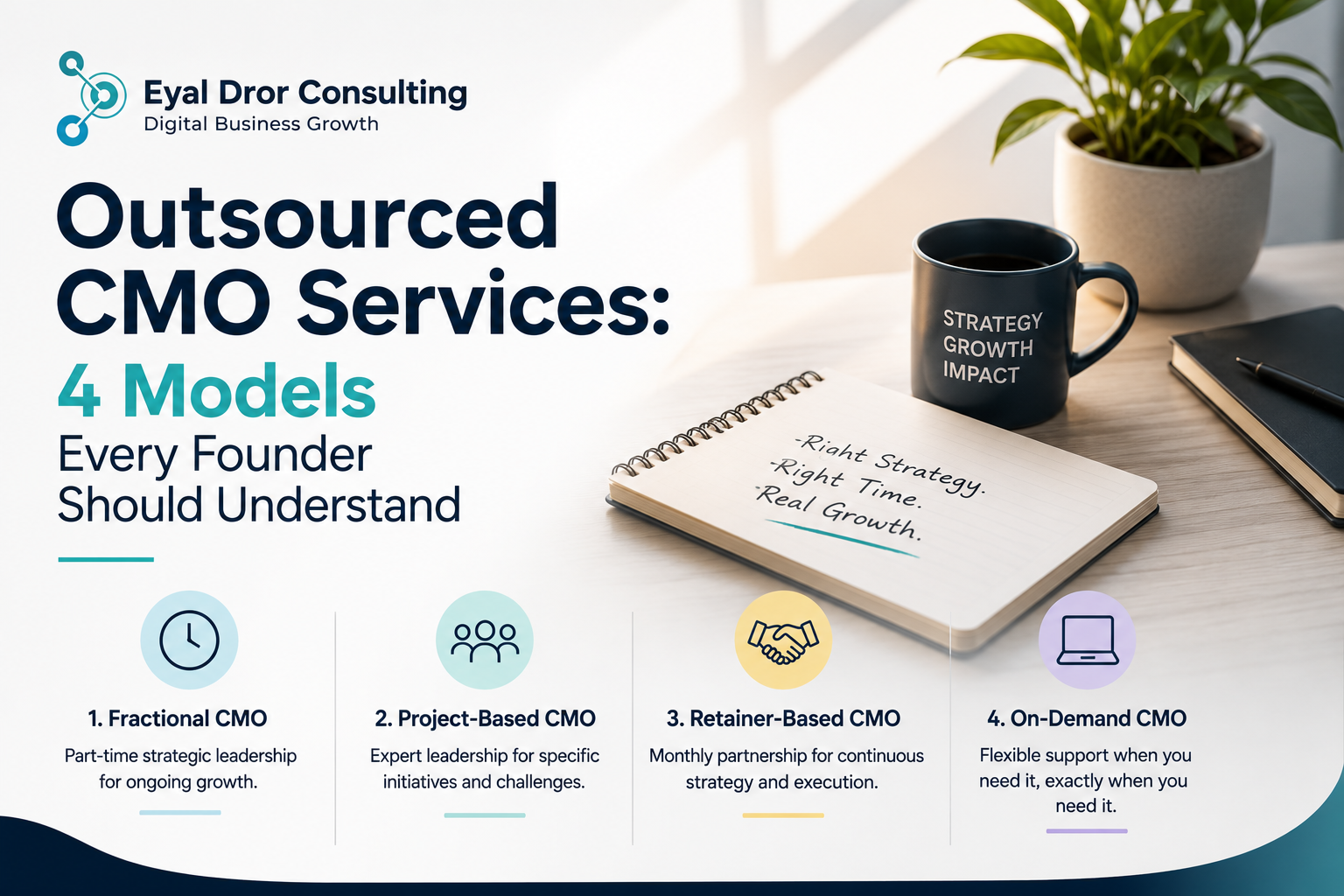
Here’s the problem with “outsourced CMO” or “Fractional CMO” as a phrase: it’s used as a single label for four genuinely different arrangements, with completely different outputs, price points, and expectations. A founder hears “outsourced CMO” and pictures one thing. The person on the other end of the contract might be selling something entirely different.
Most founders only discover this mismatch after they’ve signed, usually a month or two in, when they realize the “CMO” they hired is either too senior and too expensive for what they actually needed, or too thin on hours to ever move the needle.
My own definition, for what it’s worth: you are buying marketing leadership and strategic ownership. You are not buying execution. That distinction matters enormously, and I’ll say it a few more times in this piece because it’s the single most common source of frustration I see.
One more thing worth being upfront about, since it applies directly to how I structure my own engagements: on my end, the strategic layer sits with me. Execution, the actual campaigns, content, paid media, the operational work, sits with Vicious Marketing, a separate execution partner I work alongside. I keep that separation clean and deliberate, because conflating strategy and execution under one roof is exactly where a lot of outsourced CMO engagements go sideways. More on that below.
The 4 Models, What You Are Actually Buying
Model 1, Fractional CMO (Solo Strategist on Retainer)
This is one senior operator, working a fixed set of hours per month, with no team behind them. When I run this model, my scope covers strategy, go-to-market planning, team and vendor oversight, board reporting, and pipeline metrics.
This is the model I run most often, and here’s why: it works when a company already has an execution team in place, in-house or agency, but nobody is connecting what that team does to an actual commercial strategy. Without that execution layer already sitting somewhere, you end up with a polished strategy document that nobody implements. I’ve seen plenty of beautifully built 40-slide GTM decks gathering dust because there was no one whose job it was to actually run the plays.
When a client needs execution alongside the strategy and doesn’t already have that layer, I bring in Vicious Marketing, so the engagement doesn’t stall out at “here’s the plan” and go no further.
This model tends to fit best for companies in the $5M–$20M revenue range that already have a marketing team or agency doing the work, they just need someone senior connecting it to commercial outcomes. Typical cost runs $5,000–$15,000 a month, for roughly 10–20 hours a week.
Model 2, Outsourced CMO with Execution Team
This is a senior CMO who brings a team or agency pod behind them, strategy and execution bundled into one arrangement.
This is usually what founders think they need when they have zero internal marketing function at all, no team, no agency, nothing. And it can work well. But here’s the risk I’d flag directly: you’re paying CMO-level rates, and the actual work sometimes quietly gets handed off to junior staff while the “CMO” becomes more of an account manager checking in once a week. Vet who’s actually doing the hands-on work before you sign anything.
On my end, this looks like me operating as the CMO layer, with Vicious Marketing as the execution layer underneath, two separate contracts, one aligned output. I keep it structured that way on purpose, so you always know exactly who’s accountable for what.
This model fits best for companies with no internal marketing capability at all, typically in the $2M–$8M range. Cost runs higher than Model 1, because you’re effectively replacing both a CMO hire and an execution team’s worth of headcount.
Model 3, Virtual or Advisory CMO
This is the lightest model on the list, 4 to 8 hours a month, functioning primarily as a strategic sounding board rather than someone driving day-to-day direction.
I take these on selectively, usually for early-stage companies that aren’t ready for a full retainer yet. It works well for exactly one thing: giving a founder a sanity check before they spend meaningful money on a marketing decision. What it doesn’t work for is anything requiring someone to actually own and drive the strategy, there simply aren’t enough hours in the arrangement for that.
Best fit: pre-revenue or sub-$2M companies, or companies that already have a strong internal CMO who just wants an experienced outside perspective at the board level. Cost typically runs $2,000–$4,000 a month.
Model 4, Project-Based Engagement
This is hired for a specific, defined deliverable, a GTM plan, a rebrand, Series A marketing prep, a marketing audit ahead of a deal.
I take these on in two situations: a company that needs one specific thing built before they can move forward, or an investor who needs an independent marketing audit before closing a deal. The limitation is continuity, once the deliverable is handed over, the institutional knowledge that built it walks out the door with the consultant. There’s no ongoing relationship absorbing lessons over time.
This model fits best around inflection points, funding rounds, product launches, pivots, M&A due diligence. Cost typically runs $5,000–$25,000, depending on scope and timeline.
Side-by-Side Comparison
| Metrics | Fractional CMO | CMO + Execution Team | Virtual / Advisory | Project-Based |
| Hours/month | 40–80 (10–20 hrs/week) | 40–80+ plus team hours | 4–8 | Scoped by deliverable |
| Monthly cost | $5,000–$15,000 | Higher than Model 1 (CMO + team) | $2,000–$4,000 | $5,000–$25,000 total |
| Execution included | No, pairs with existing team or agency | Yes, team/pod included | No | Deliverable-specific, sometimes |
| Best revenue stage | $5M–$20M | $2M–$8M | Pre-revenue to sub-$2M | Any stage, tied to inflection point |
| Commitment length | Ongoing retainer | Ongoing retainer | Ongoing, light-touch | Fixed, ends at deliverable |
What an Outsourced CMO Actually Does Day-to-Day
Let me clear up a misconception I run into constantly: the CMO does not write your copy, run your ads, or manage your social calendar. If that’s the help you’re picturing, you need a specialist or an agency, not a CMO, outsourced or otherwise.
What I actually own in a retainer is marketing system ownership: go-to-market strategy, team and vendor management, pipeline metrics, board reporting, positioning, and investor communication. That’s the job. It’s leadership and strategic ownership, not hands-on-keyboard execution.
Concretely, here’s what that looks like in practice. In a typical retainer, I’ll spend the first 30 days doing a full audit, current positioning, team structure, pipeline data, existing channel performance. Nothing gets built until we actually know what’s broken. I’ve watched too many engagements skip straight to “let’s launch a new campaign” without anyone confirming the campaign is solving the right problem in the first place.
The Full-Time CMO Cost Comparison, The Honest Version
Let’s talk real numbers, because the full-time comparison usually gets oversimplified to “salary vs. retainer,” and that’s not the honest version.
A full-time CMO’s all-in cost isn’t just base salary. It’s bonus, equity, employer taxes, benefits, and recruiting fees that typically run 20–25% of first-year salary, plus a 3–6 month ramp period before that hire is actually producing results. For a $2M–$10M company, that all-in Year 1 cost for a single full-time CMO hire typically lands somewhere between $400,000 and $600,000.
Compare that to fractional, which usually runs $60,000–$180,000 a year for a senior operator who’s already seen the same problems play out across multiple verticals, not learning your industry on your dime.
I’ll be straight about the limits here, though: the fractional model isn’t always the right answer. If you’re at $50M+ with a 15-person marketing team already in place, you need a full-time CMO running that org day to day. But for the $2M–$20M range specifically, the cost-to-output ratio almost always favors fractional.
How to Choose, My 3-Question Framework
When founders ask me which model fits, I run them through three questions:
- Do you have an execution team already? If yes, a Fractional CMO (Model 1) is usually the fit, you need the strategic layer connecting the dots. If no, you’re looking at Model 2, or you need to build an execution team first.
- Is this an ongoing leadership need, or a specific problem to solve? Ongoing need points to a retainer model. A specific, bounded problem points to Model 4, project-based.
- What’s your monthly marketing budget beyond the CMO fee itself? If it’s under $5,000 a month, fix that first, otherwise the engagement stalls out with nothing left to actually execute the strategy against.
If you’re still unsure after working through those three questions, that uncertainty is itself useful information. It usually means you haven’t fully diagnosed the real constraint in your business yet, which is exactly what a first conversation is for.
3 Things to Check Before You Hire Any Outsourced CMO
- Relevant vertical and stage experience. A B2C-focused CMO advising a B2B SaaS company adds noise, not signal. Make sure the experience actually maps to your world.
- A defined first-90-day plan, before you sign. Any serious operator can articulate this clearly in a first call. Vagueness here predicts vagueness once the engagement starts.
- Clarity on who actually executes. Strategy without execution is just a document sitting in a folder. Confirm, before day one, exactly who does the work and who owns the output.
FAQ
What is the difference between a fractional CMO and an outsourced CMO?
The terms get used interchangeably, but there’s a real structural difference. A fractional CMO typically means one senior strategist working part-time hours. “Outsourced CMO” can also refer to a CMO-led team handling both strategy and execution together. Know which one you’re actually buying before you sign the contract.
How many hours does an outsourced CMO work per month?
It depends on the model. Fractional retainers typically run 20–40 hours a month. Advisory models run 4–8. A project-based engagement is scoped by deliverable rather than hours, so the hour count matters less than the defined output.
When should you not hire an outsourced CMO?
If what you actually need is execution, ads, content, social, hire specialists or an agency instead. An outsourced CMO without an execution team behind them produces a strategy that sits in a deck and goes nowhere. Also worth avoiding if your monthly marketing spend is under $5,000, there’s nothing substantial for a CMO to lead yet.
What does a typical first 30 days look like?
Audit first, build second. The first month should be a full diagnostic, positioning, pipeline data, team structure, existing channel performance. Any CMO who wants to start building campaigns before diagnosing the actual problem is a red flag, not a sign of speed.
Conclusion
Four models, one label. The model that fits you depends on whether you already have an execution team, whether your need is ongoing or a defined deliverable, and whether your budget can actually support execution once the strategy is built.
If you’re in the $2M–$20M range and trying to work out which model fits your business, I run a 30-minute strategy clarity call before any engagement starts. No pitch, no sales deck, just a diagnostic conversation to figure out whether there’s a real fit and what that would actually look like.
And if what you actually need is the execution layer, not just the strategy, that’s what Vicious Marketing handles.

Leave a Comment