
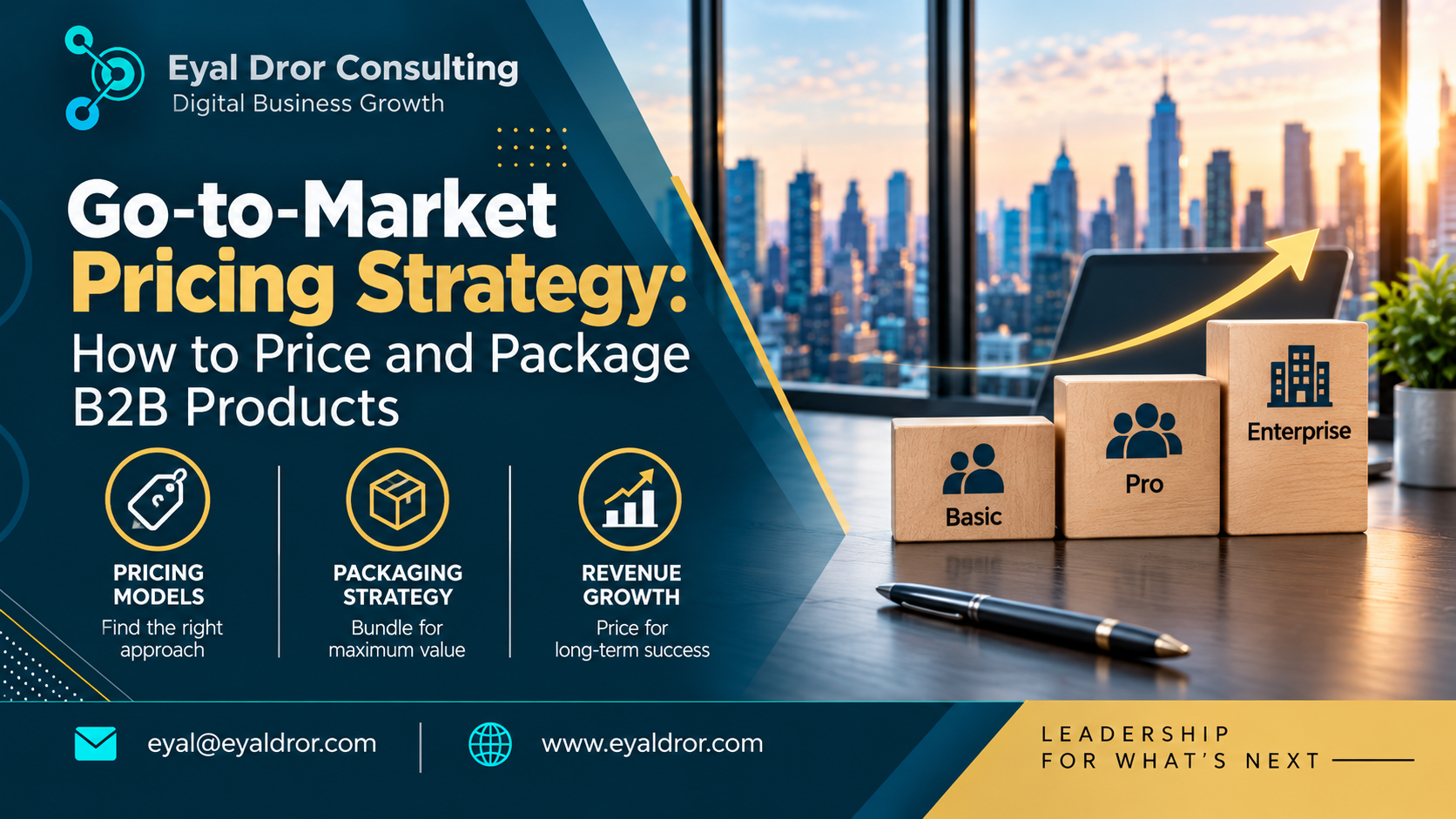
Go-to-Market Pricing Strategy plays a critical role in the success of any B2B product launch. Price too low and you leave money on the table while potentially signaling that your product isn’t worth much. Price too high and deals stall. Package your product poorly and buyers struggle to understand its value. Pricing and packaging can make or break a B2B launch, yet many teams leave these decisions until the week before release. The real challenge is choosing the right pricing model, understanding what customers are willing to pay, protecting profit margins and standing out from competitors.
A go to market pricing strategy gives you a structured way to line up product value, customer expectations and revenue goals. If you’d like expert input, Go-to-Market Strategy Consulting is built for this.
What Is a Go-to-Market Pricing Strategy?
A go to market pricing strategy is the plan for how you price and package a product as you launch it or enter a new market. It connects to customer segmentation, positioning, packaging and your revenue targets.
Three terms get mixed up, so let’s separate them. Your pricing strategy is the overall approach, such as premium or competitive. Your pricing model is the mechanism, such as per-seat or usage-based. Your packaging is how features are bundled into offers. They work together, but they’re not the same decision. For the wider context, read our go-to-market strategy consulting guide.
How to Build a Successful Go-to-Market Pricing Strategy
Step 1: Identify Your Target Customers and Their Willingness to Pay
Start with who you’re selling to. Look at ideal customer profiles, buyer needs, budgets and how they perceive your product’s value. Then talk to them. Customer interviews and pricing research tell you more than any spreadsheet. Here’s the thing: willingness to pay is about perceived value, not your costs.
Step 2: Analyze Competitor Pricing and Market Positioning
Study competitor pricing models, compare products and look at market benchmarks. The goal isn’t to copy them. It’s to find where you can position yourself clearly, whether as the premium choice, the simpler choice or the specialist.
Step 3: Choose the Right B2B Pricing Model
Each model suits different situations:
- Subscription-based: It is predictable recurring revenue and easy to understand. It can undercharge heavy users.
- Per-user or seat-based: This model is simple and scales with team size. It can discourage adoption if every seat costs money.
- Usage-based: It aligns price with value received but revenue is harder to forecast.
- Tiered pricing: This model serves different segments with different packages. Too many tiers cause confusion.
- Value-based pricing: In this, it ties price to the outcome delivered. It needs a clear way to measure that value.
- Custom enterprise pricing: This is flexible for complex, large deals. It slows sales cycles and needs discipline.
There’s no universally best choice. Match the model to how customers get value.
Step 4: Develop Product Packaging and Pricing Tiers
Define which features go to which segment. Many companies build basic, professional and enterprise packages, with bundles that make each step feel natural. Decide between a free trial, which gives time-limited full access, and freemium, which offers a permanently limited free version. They serve different goals. If you want help shaping packages around your market entry, Go-to-Market Strategy Consulting can guide you.
Step 5: Calculate Pricing Based on Costs and Revenue Goals
Now check the numbers. Look at customer acquisition cost (CAC), gross margins and customer lifetime value (CLV). Run a break-even analysis and confirm each package is profitable. The truth is, a price that wins deals but loses money isn’t a strategy. The aim is a price that’s competitive and sustainable. For more on balancing growth and unit economics, see Growth Strategy Consulting.
Step 6: Test and Validate Your Pricing Strategy
Don’t launch on a guess. Use willingness-to-pay surveys, pilot programs, price sensitivity testing, controlled experiments and customer feedback. Validate before a full launch, because changing prices later is harder than testing them first.
Step 7: Launch Your Pricing Strategy and Monitor Performance
Communicate pricing clearly. Train sales teams on the value story, and set discounting rules so deals don’t erode margin. Then watch the metrics: conversion rate, average contract value (ACV), CAC, gross margin and retention. What most people miss is that pricing isn’t finished at launch. It’s a live system. Revenue Operations Consulting can help you set up that monitoring.
Common B2B Pricing and Packaging Mistakes to Avoid
- Setting prices based only on competitors. Their costs and strategy aren’t yours.
- Offering too many tiers or complicated packages. Confused buyers don’t buy.
- Ignoring willingness to pay. Cost-plus pricing can miss the value you deliver.
- Discounting excessively. It trains customers to wait for a deal and hurts margin.
- Forgetting implementation, support and servicing costs. They can quietly eat profit.
- Never reviewing pricing. Customer needs and the market change.
If any of these ring true, Go-to-Market Strategy Consulting can help you reset.
Frequently Asked Questions
What is the best pricing strategy for B2B products?
There isn’t one. It depends on your customers, product and market. Value-based, tiered and subscription approaches are common, but test what fits how your buyers see value.
How do you determine the right price for a new B2B product?
The effective way to determine the right price is to combine customer research, competitor analysis and cost and margin analysis. Then test with real buyers. The right price is where perceived value, competitiveness and profitability align well.
What is the difference between pricing strategy and product packaging?
Pricing strategy is your overall approach for setting the price. Packaging is how you bundle features and group them into offers. Both shape what customers pay and what they get.
How many pricing tiers should a B2B SaaS product have?
Enough to serve your main segments, without confusing buyers. Many companies use around three, but the right number depends on your customers. Keep it simple.
How often should businesses review their pricing strategy?
Regularly, and whenever something major changes, such as a new product, new segment or shift in competition. An annual review is a common starting point.
Conclusion
A strong go to market pricing strategy rests on customer research, the right pricing model, clear packaging, healthy unit economics and ongoing optimization. Price for the value you deliver, and it’ll support sustainable revenue growth. If you’re planning a launch or new market entry, build a pricing and packaging strategy to match it with Go-to-Market Strategy Consulting.
