
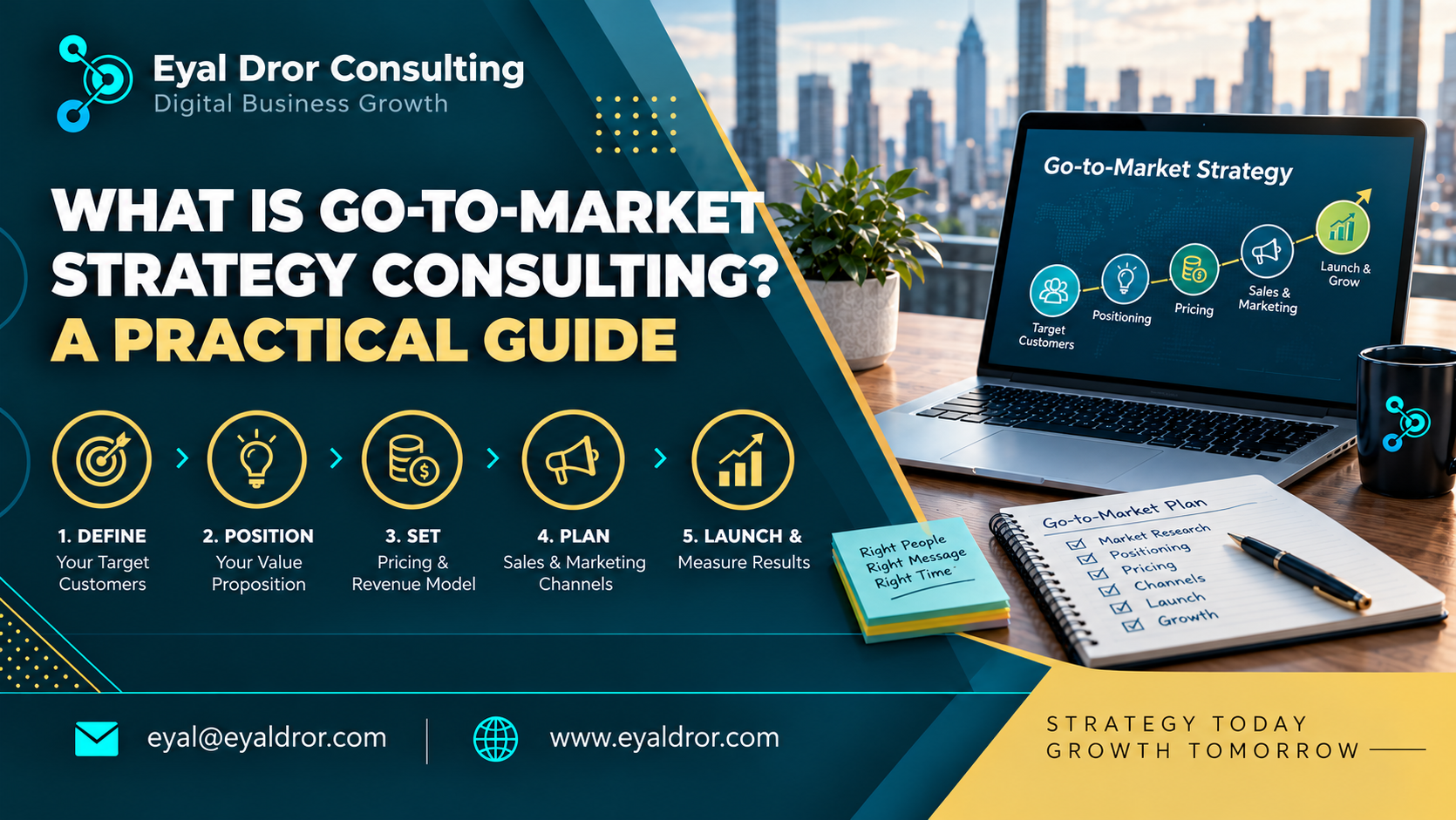
Go-to-market strategy consulting helps a business plan how a product or service will reach the right customers and generate revenue. It matters most at moments of risk: a product launch, a new market or a push to grow beyond the first wave of customers.
A structured approach connects five things that often get handled separately: product positioning, target customers, pricing, sales and marketing. This guide explains what the consulting involves, the key components of a strategy, how the process works step by step, and the mistakes to avoid.
What Is Go-to-Market Strategy Consulting?
Go-to-market strategy consulting is outside expertise that plans a successful market entry. A consultant works with you to define who you are selling to, why they should choose you, how you will price and sell, and how you will launch.
GTM consulting aligns your business objectives with customer needs, competitive positioning and distribution channels. The aim is a plan where every decision, from messaging to sales channel, supports the same goal.
Businesses typically look for go-to-market consulting services when launching a new product, entering an unfamiliar market, moving beyond founder-led sales, or when growth has stalled because acquisition, conversion or channel economics are holding them back.
Why Is a Go-to-Market Strategy Important?
A go-to-market strategy does four jobs:
- Reduces uncertainty when launching a product or entering a new market.
- Aligns sales, marketing and product teams around shared goals.
- Improves customer targeting, resource allocation and launch planning, so money goes where it works.
- Identifies market risks before you commit significant resources.
Without it, teams often work hard in different directions. With it, effort compounds.
Key Components of a Go-to-Market Strategy
1. Target Market and Customer Segmentation
Begin by defining customer personas (types), ideal customers, and priority market segments. Then understand what those customers want, their needs, their demand and how they do buy. Doing your best to please everyone generally means that you’re pleasing no one.
2. Value Proposition and Product Positioning
Clearly identify the problem your product or service solves, and explain what’s unique about you and the value you offer the customer. It’s clear messaging for each target audience, so buyers know right away why you are the best option.
3. Pricing and Revenue Model
Evaluate pricing approaches, what customers are willing to pay and the competitive alternatives. Then link price with your business goals and customers’ perception of value to ensure that price reinforces, rather than weakens, your positioning.
4. Sales and Marketing Channels
Select the acquisition channels and sales model that works best for your customer and transactions. Align marketing initiatives, follow-up sales and lead generation, and assign accountability to each team to ensure leads are not lost.
5. Launch Planning and Performance Metrics
Draw up a launch roadmap including milestones, owners and resources. Identify KPIs (qualified leads, conversion rates, customer acquisition cost/revenue etc), establish a system to track performance and enhance results.
How Go-to-Market Strategy Consulting Works
Step 1: Assess Business Goals and Market Readiness
Revisit business goals, Product readiness, existing capabilities and your market assumptions. This is how you can do it today, and what you need to work on first.
Step 2: Research the Market and Competition
Understand customers, competition, gaps and barriers to entry. The idea is to challenge the idea with evidence before developing it.
Step 3: Develop the GTM Strategy
Identify target groups, positioning, pricing and revenue goals. This is the crucial decision making moment when the choices become clear and narrow down to a definite plan.
Step 4: Build the Go-to-Market Action Plan
Establish launch activities, timelines, team responsibilities and resources. An action plan can only be effective if someone is responsible for each action and is able to implement it.
Step 5: Measure Results and Optimize
Track KPIs, evaluate customer response and refine the strategy based on performance. Initial results will nearly always indicate something to be changed.
Common Go-to-Market Strategy Mistakes to Avoid
Most failed launches trace back to a short list of errors:
- Targeting an overly broad audience.
- Using unclear product positioning or value propositions.
- Choosing sales and marketing channels without validating customer behavior.
- Setting unrealistic launch targets or overlooking resource requirements.
- Failing to track performance and adapt the strategy.
For a real example of how this plays out, read about the common go-to-market strategy mistakes behind one failed launch and what could have been done differently.
How Eyal Dror Supports Go-to-Market Strategy Development
Eyal Dror helps businesses clarify positioning, identify target markets and coordinate sales and marketing activities around one plan. The work is built around your business objectives and measurable outcomes, so each GTM priority connects to a result you can track.
You can see the full approach on the Go-to-Market Strategy Consulting service page. If you are planning a launch or entering a new market, explore Eyal Dror’s consulting support and start with a conversation about your goals.
Frequently Asked Questions
1. What Is Go-to-Market Strategy Consulting?
Go to market strategy consulting is a process of developing and implementing a product or service into the market place. A consultant targets segments, positions, prices, markets, and plans the introduction of the product into the market, without relying on guesswork.
2. What Do Go-to-Market Consulting Services Include?
These usually encompass market/competitive analysis, customer segmentation, positioning/messaging, pricing, channel/sales model selection and a launch roadmap with KPIs. Some engagements are also committed to providing continuous advisory on results and modifying the plan once the launch takes place.
3. When Should a Business Hire a GTM Consultant?
Consider one when you are launching a new product, entering an unfamiliar market, moving away from founder-led sales, or seeing stalled conversion or misalignment between sales and marketing. The best time is before you decide the launch budget.
4. What Is the Difference Between a Go-to-Market Strategy and a Marketing Strategy?
A marketing strategy focuses on awareness, demand generation, content and paid media. A go-to-market strategy is broader. It covers target customers, positioning, pricing, sales model and launch planning, so marketing is one part of it, working alongside sales and product.
5. How Long Does It Take to Develop a Go-to-Market Strategy?
A GTM strategy project is usually completed within 6–8 weeks and can take 6–12 weeks for a more extensive engagement. The timing is dependent on scope, data availability and decision speed. It can take a couple of months more to get things done after the initial execution.
6. How Do You Measure the Success of a Go-to-Market Strategy?
Measure it against KPIs set before launch, such as qualified leads, conversion rates, customer acquisition cost and revenue. Check results against targets, monitor customer response and evaluate strategy regularly. Tracking consistently provides what to tweak and what to repeat.
