
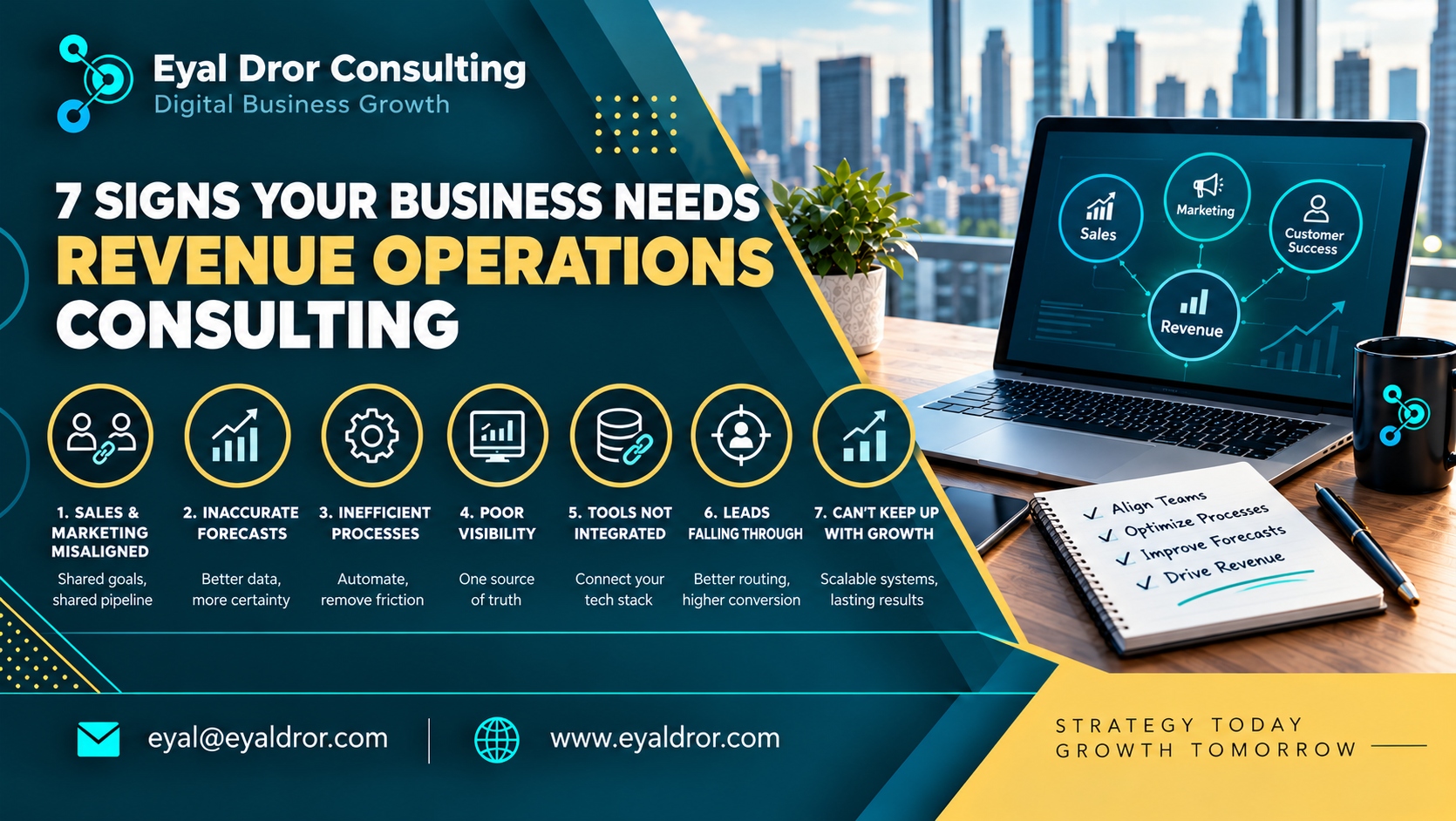
Growth gets harder when the teams that produce revenue don’t work from the same playbook. Sales, marketing and customer success each keep their own data, their own definitions and their own workflows. Leads get lost, forecasts miss and everyone spends time arguing about whose numbers are right.
Revenue operations consulting is an approach that aligns sales, marketing and customer success around shared processes, data and goals. If any of the seven signs below sound familiar, your business may be ready for RevOps support.
What Is Revenue Operations Consulting?
Revenue operations consulting aligns people, processes, data and technology across the whole customer lifecycle. Instead of fixing one department at a time, it treats revenue as a single system.
A revenue operations consultant reviews how that system works today, identifies the gaps that cost you revenue, and designs the fixes. Typical revenue operations services support forecasting, pipeline management, reporting and cross-functional collaboration, so every team works from the same information.
7 Signs Your Business Needs Revenue Operations Consulting
1. Your Sales and Marketing Teams Are Misaligned
Conflicting goals, unclear lead definitions and poor communication all hurt revenue. Marketing celebrates the number of leads and sales are complaining about the quality of leads. There’s no consensus on what a qualified lead is.
Watch for poor lead quality, lost passes. RevOps consulting sets up common KPIs and streamlined processes, ensuring that both teams report on the same thing — revenue.
2. Your Revenue Forecasts Are Frequently Inaccurate
When forecasts come in a lot of times short, the reason is most often due to poor quality pipeline data and inconsistent reporting and sales estimates. If the outcome of a deal is reliant on who updates it, then there is no way to resolve the problem with any model.
Predictable processes and reliable data are repeatable. Leaders can then plan to hire, spend and target with confidence, and not hope.
3. Your Sales Processes Are Inefficient
Productivity slowly leaks out by rote learning and unclear processes/delays between sales stages. Reps waste hours on data entry and admin, rather than conversing with buyers.
Optimizing and automating processes eliminate that friction. Standardization and automating repetitive tasks enable teams to spend more time on selling.
4. You Lack Clear Visibility Into Revenue Performance
Poor reporting system, lack of metrics and challenges with tracking the customer journey make it difficult to know what is working. Two dashboards provide two different responses to the same question.
This is where centralized reporting and consistent KPIs come in. Leaders can identify issues early on and make informed investment decisions with one version of the truth.
5. Your CRM and Revenue Tools Are Not Working Together
Common symptoms of a tool stack that has grown without a plan include disconnected platforms, duplicate data, underused features and manual data entry. There is a CRM, but people don’t believe it.
A revenue ops consultant may analyze CRM integration, data quality and technology workflows. Frequently, the solution isn’t buying a new tool but using the ones you already own more effectively, and linking them together more effectively.
6. Leads and Sales Opportunities Are Falling Through the Cracks
Delayed follow-ups, unclear ownership, weak lead qualification and inconsistent pipeline stages mean good opportunities go cold. Everyone assumed someone else was handling it.
Improved lead routing, handoff rules and pipeline management reduce missed opportunities. Every lead gets an owner, a deadline and a clear next step.
7. Your Business Is Growing, but Revenue Operations Cannot Keep Up
Processes that worked for a small team often fail as the company scales. The more people, products and customer segments, the more complicated it gets, and the harder it is to report on and keep up performance.
A scalable revenue ops strategy is a growth plan. It establishes replicable processes to grow with as you add more team members onto the project.
How Revenue Operations Consulting Helps Address These Challenges
Consultants start by assessing current processes and finding the underlying causes of revenue inefficiencies. Any symptom, including a missed forecast, will go back to a cause that may be unclear stage definitions, poor handoffs, etc.
The work then typically involves sales and marketing alignment, CRM optimization, pipeline management, forecast, and performance reporting.
Not all things will be fixed in one fell swoop, so priorities are important. Businesses can prioritize changes based on the objective and the measurable KPIs, such as the forecast accuracy, lead-to-opportunity conversion, pipeline velocity, net revenue retention and so on.
When Should You Hire a Revenue Operations Consultant?
Bring in specialist support when the same operational issues keep coming back. If you have fixed the report, the field or the process more than once and the problem returns, the cause is probably structural.
It also makes sense when internal teams lack the time or expertise to improve revenue processes. Your people are busy running the business, and redesigning a revenue system takes dedicated focus.
Consulting is especially valuable during rapid growth, organizational changes, or CRM and technology transitions. Those are the moments when small gaps become expensive and when good design is cheapest to build in.
How Eyal Dror Supports Revenue Operations Improvement
Eyal Dror helps businesses improve team alignment, process efficiency and revenue visibility. The work starts by finding where revenue breaks today, then designs the lifecycle, handoffs, reporting and forecasting that fix it.
You can see the full scope on the Revenue Operations Consulting service page. If two or three of the signs above sound like your business, explore consulting support and start with a conversation about where your revenue breaks.
Frequently Asked Questions
1. What Does Revenue Operations Consulting Include?
It typically includes a revenue operations audit, strategy, lifecycle and funnel design, sales and marketing alignment, CRM optimization, pipeline management, forecasting, reporting and workflow automation. The exact scope depends on your gaps and goals.
2. How Do I Know If My Business Needs RevOps Consulting?
Look for warning signs such as unreliable forecasts, friction between sales and marketing, leads lost in handoffs, poor CRM data, manual reporting and disconnected customer success. If two or three apply, a review is worth doing.
3. What Does a Revenue Operations Consultant Do?
A revenue operations consultant diagnoses where revenue leaks, then designs the processes, data structure and tool setup to fix it. They align teams around shared metrics and can help implement changes in the CRM, workflows and reporting.
4. Which Businesses Benefit Most From Revenue Operations Services?
B2B companies with multiple revenue teams, several tools and growing complexity benefit most. Companies between $1M and $30M in revenue typically see the greatest return, because that is when teams, tools and customer stages begin to collide.
5. How Does Revenue Operations Consulting Improve Sales and Marketing Alignment?
It creates shared definitions, KPIs and handoff rules, so both teams agree on what a qualified lead is and who owns it at each stage. With common data and goals, disputes over lead quality give way to joint accountability for revenue.
6. How Can Revenue Operations Consulting Support Business Growth?
It makes revenue more predictable by improving forecasting, visibility and conversion, and by removing manual work. It also builds repeatable processes that scale, so growth does not depend on individual effort or strain the systems behind it.
