
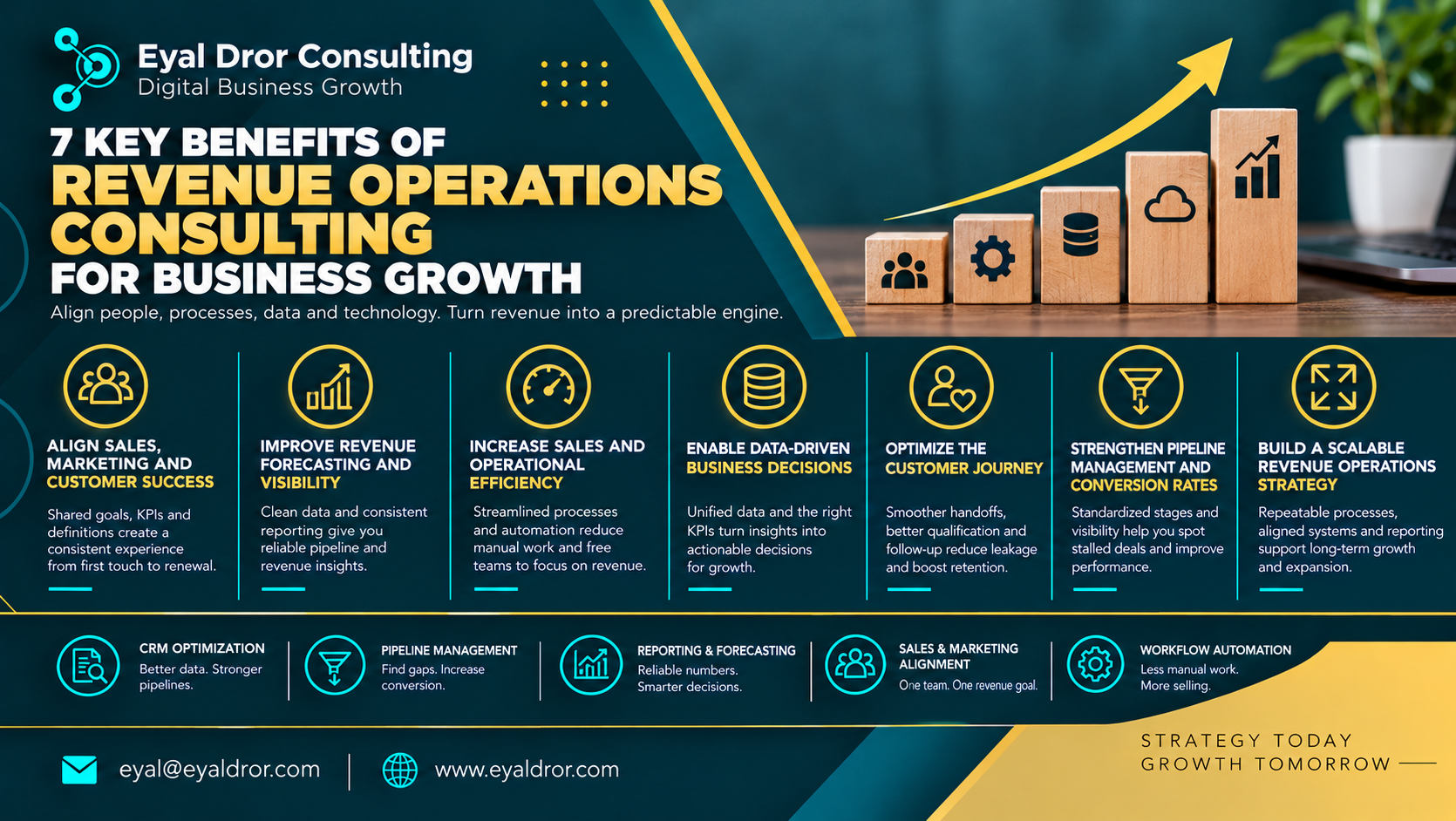
Revenue operations consulting helps a business align its people, processes, data and technology so revenue becomes predictable instead of accidental. For growing B2B companies, it is often the difference between teams that work hard and teams that work together.
When sales, marketing and customer success run on separate tools, definitions and goals, deals stall in handoffs and nobody trusts the numbers. Aligning the three improves every revenue process, from lead capture to renewal. Below are seven benefits you can expect, and how a structured revenue operations strategy ties them together.
What Is Revenue Operations Consulting?
Revenue operations consulting is outside expertise that reviews how your revenue engine actually works and then redesigns the parts that leak. It looks at the whole customer lifecycle, not one department at a time, and connects people, processes, data and technology around shared goals.
Good revenue operations services start with a diagnosis. They find the operational gaps, such as unclear lead stages, messy CRM data, slow handoffs and reports that disagree, and then prioritize fixes by their effect on revenue.
A unified approach matters most for growing B2B businesses. Once you have multiple teams, tools and customer stages, small mismatches multiply. Fixing them one team at a time rarely holds.
7 Key Benefits of Revenue Operations Consulting
1. Align Sales, Marketing, and Customer Success
The first benefit is a shared way of working. Consulting establishes common goals, KPIs and definitions, so a “qualified lead” or a “closed deal” means the same thing in every team.
Lead handoffs get clearer, communication improves, and customers get a consistent experience from first touch to renewal, instead of feeling passed between departments.
2. Improve Revenue Forecasting and Visibility
Inconsistency in the underlying data fails the forecasting. Revenue Operations Consulting straightens out how the data is recorded and communicated, giving you the ability to monitor the pipeline’s and revenue’s performance reliably.
The outcome is improved business planning. You will be able to make decisions regarding staffing, budgeting, and targets based on reliable data rather than intuition.
3. Increase Sales and Operational Efficiency
Consultants chart processes in order to identify bottlenecks and recurring actions that hamper their performance. Standardization of the process and automation of certain tasks like data input and reminders helps save time.
That time goes where it matters. Reps spend more of it selling, and operations teams spend more of it improving the system.
4. Enable Data-Driven Business Decisions
Revenue data often sits in several tools, each telling a partial story. Consulting consolidates it into reports people can act on.
The use of appropriate KPIs helps you identify any areas that have room for improvement. Decisions regarding where resources should be invested are based on facts rather than opinions.
5. Optimize the Customer Journey
Revenue leaks at the transitions: marketing to sales, sales to customer success. Consulting smooths those moments, strengthens lead qualification and tightens follow-up so promising prospects are not lost.
A better journey also supports retention and expansion, because existing customers get the same attention as new ones.
6. Strengthen Pipeline Management and Conversion Rates
Standardized pipeline stages and sales processes make performance comparable across the team. You can spot stalled deals, find where conversion drops, and see how each rep and segment performs.
That visibility turns pipeline reviews from status updates into decisions about what to fix.
7. Build a Scalable Revenue Operations Strategy
The last benefit is the one that lasts. A revenue operations strategy creates repeatable processes that support expansion, ties your systems to long-term business goals, and is designed to adapt as you grow.
Workflows, systems and reporting that suit a 20-person company will strain at 100. Building for the next stage now avoids rebuilding later.
How Revenue Operations Services Support Business Growth
Consulting identifies where your revenue operation is inefficient and where the opportunities are. Typical revenue operations services cover CRM optimization, pipeline management, reporting, forecasting and cross-functional alignment.
Not everything can be fixed at once, so priorities matter. A good engagement ranks improvements by your goals and by measurable KPIs, such as forecast accuracy, lead-to-opportunity conversion, pipeline velocity, CRM completeness and net revenue retention. You start with the changes that move those numbers most.
Timing is a factor too. Companies between $1M and $30M in revenue typically see the greatest return, because that is when multiple teams, tools and customer stages begin to collide. A diagnostic audit usually takes two to four weeks, and a full design and implementation engagement often runs three to six months.
How Eyal Dror Helps Businesses Improve Revenue Operations
Eyal Dror works with founders and revenue leaders to improve alignment, processes and revenue visibility. The work begins with finding where revenue breaks today, then designing the lifecycle, handoffs, reporting and forecasting that fix it.
You can learn more about the full scope on the Revenue Operations Consulting service page. For a deeper look at what an engagement delivers, read our guide to the benefits of revenue operations consulting.
If your numbers disagree across teams or your forecast keeps missing, explore Eyal Dror’s consulting services and start with a conversation.
Frequently Asked Questions
1. What Is Revenue Operations Consulting?
Revenue operations consulting is outside expertise that aligns sales, marketing and customer success around shared processes, data and goals. A consultant diagnoses where revenue leaks, then designs and builds the system, covering the CRM, handoffs, reporting and forecasting, so growth becomes more predictable.
2. What Are the Main Benefits of Revenue Operations Consulting?
Benefits include improved team alignment, more accurate forecasting, increased efficiency, decision-making based on facts, an enhanced customer experience, better pipeline conversion, and scalability. Collectively, they provide business leaders with increased visibility of their revenues and ensure that teams focus on revenue-building activities.
3. What Do Revenue Operations Services Include?
The Revenue Operations services can consist of a combination of auditing, strategy development, design of lifecycle and funnel, sales and marketing alignment, CRM optimization, pipeline management, forecasting, and workflow automation. The specifics will depend on what areas you lack in and what is more important for achieving your revenue goals.
4. How Does a Revenue Operations Strategy Improve Business Growth?
A revenue operations strategy involves setting up processes that can be replicated and a reporting system that is consistent such that growth is no longer reliant on the efforts of any single individual. The systems are aligned to the future plans, minimizes duplication of effort through handoffs, and provides accurate data.
5. Which Businesses Benefit From Revenue Operations Consulting?
B2B companies with multiple revenue teams, several tools and growing complexity benefit most. Companies with a revenue range of $1M to $30M usually experience the best results. Red flags are untrustworthy forecasting, conflict between sales and marketing, and lost leads.
6. How Can Businesses Measure the Success of Revenue Operations Consulting?
Track a small set of KPIs against a baseline set at the start. Common ones are forecast accuracy, lead-to-opportunity conversion, pipeline velocity, CRM completeness and net revenue retention. Improvement in these, along with less manual reporting, shows the system is working.
