
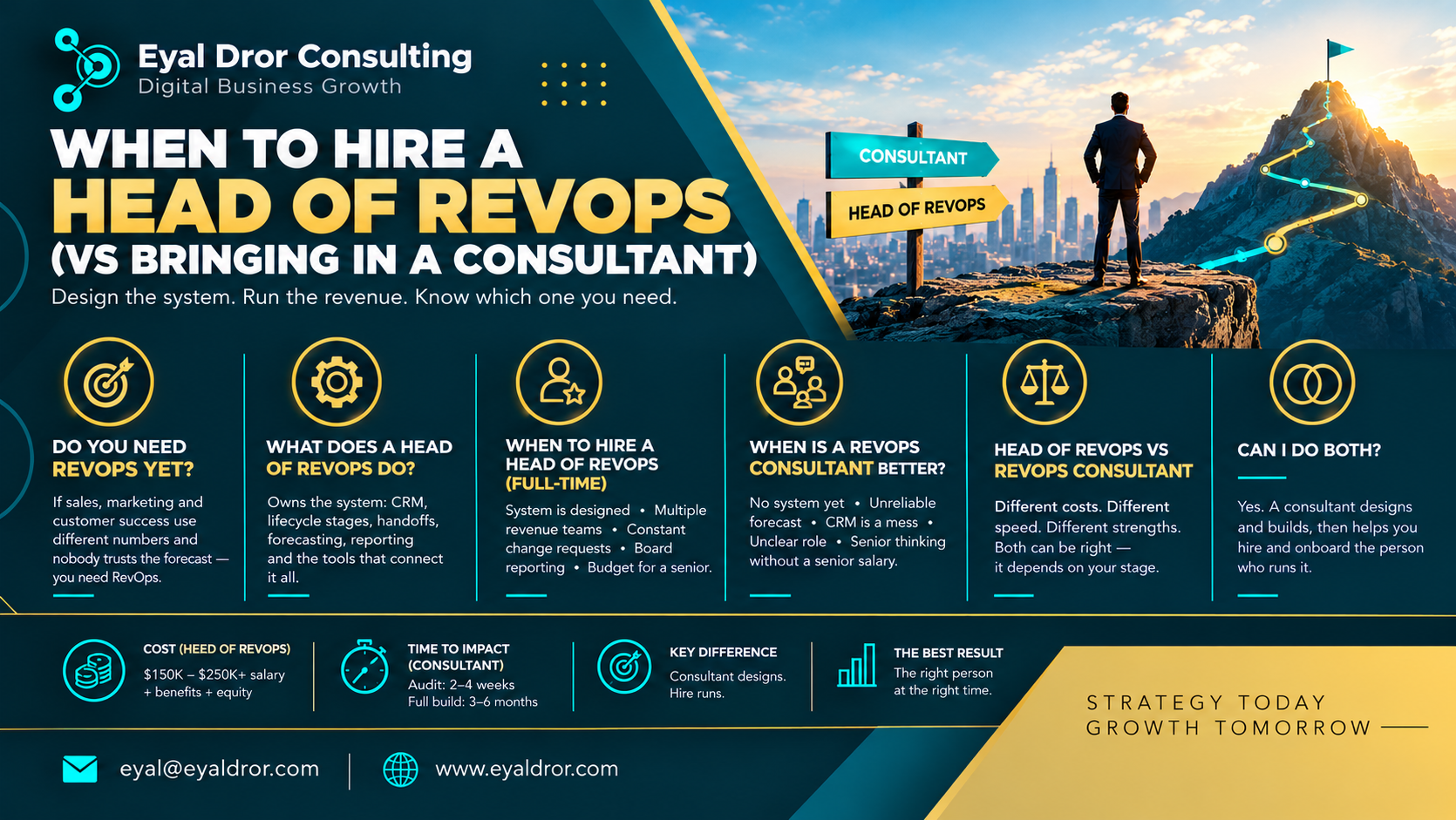
Should I hire a Head of RevOps, or bring in a consultant? It’s the question I hear most from founders who feel their revenue engine is leaking but can’t say where.
Here’s the short answer. It depends on whethera you need someone to design the revenue system or someone to run it. Most companies need the first before the second. That’s why the right time to hire a Head of RevOps is usually after the system exists, and why revenue operations consulting often comes first. Below, I’ll walk you through how to tell which one you need.
Do I Even Need RevOps Yet?
You need RevOps if sales, marketing and customer success each use different numbers and nobody trusts the forecast. If that sounds like your last board meeting, the answer is yes.
So, do I need a RevOps team? Not necessarily a team. You need someone responsible for the system. And when do you need revenue operations at all? Stage matters here. Below $1M in revenue, your priority is usually finding product-market fit, not building process. Companies between $1M and $30M typically see the greatest return, because that’s when multiple teams, tools and customer stages start to collide.
If you’re in that range and the numbers don’t match across teams, you’re ready to look at it.
What Does a Head of RevOps Actually Do?
A Head of RevOps owns the system behind your revenue. That means the CRM, lifecycle stages, handoffs between teams, forecasting, reporting and the tools that connect them.
Think of it as the machine your revenue team runs on. They make sure a lead moves from marketing to sales without getting lost, that a deal stage means the same thing to everyone, and that the forecast you show your board is built on clean data.
Here’s what they don’t do. They don’t carry a quota. They don’t run the sales team or own the revenue number. That’s a CRO’s job. RevOps builds and maintains the system, and the CRO uses it to hit the target.
When to Hire a Head of RevOps Full-Time: What Are the Signs?
Hire a full-time Head of RevOps when the system is already designed and needs someone to own it every day. If you’re wondering when to hire a head of RevOps, look for these five signs:
- The system is designed and needs daily ownership. The architecture exists. It now needs someone to maintain it, enforce it and improve it.
- You have multiple revenue teams. SDRs, account executives and customer success all touch the same customer, and handoffs are where deals leak.
- Change requests never stop. New fields, new reports, new workflows. Every week there’s something, and it’s eating other people’s time.
- The board wants reporting every month. Investors and directors expect a clean pipeline, forecast and retention data on a regular cadence.
- You have the budget for a senior hire. A strong Head of RevOps is a senior role, and it should be funded like one.
If you can tick most of these, you’re probably past the design stage. You need an owner.
When Is a RevOps Consultant the Better Call?
A consultant is the better call when nobody has designed the system yet, or when something is broken and you need it fixed fast. When people ask me about RevOps consultant vs full-time hire, these are the five signs that point to the consultant:
- Nobody has designed the system. You’ve grown by adding tools and people, but there was never a plan for how it all fits together.
- The forecast is unreliable and you need it fixed this quarter. A hire takes months to land. A consultant can start on the problem right away.
- The CRM is a mess. Duplicate records, inconsistent stages, missing data. Someone needs to untangle it before anyone can run it.
- You can’t define the role well enough to hire it. If you can’t write the job description with confidence, you’ll hire the wrong person.
- You need senior thinking without a senior salary. You want an experienced architect for the build, not a permanent cost.
If most of these sound familiar, start with a consultant.
Head of RevOps vs RevOps Consultant: How Do They Compare?
Here’s the side-by-side.
| Head of RevOps (full-time) | RevOps consultant | |
| Cost | $150K to $250K+ in salary, benefits and equity | A scoped engagement, then optional monthly advisory |
| Time to impact | Months to hire, then time to ramp | Audit in 2 to 4 weeks, full build in 3 to 6 months |
| Best at | Owning and improving the system every day | Designing the system and fixing what’s broken |
| Best stage | Designed system, multiple revenue teams | No system yet, or a system that’s failing |
| Main risk | Hiring against a vague job description | Nobody owns it after the engagement ends |
The takeaway: a consultant designs, a hire runs. Pick the one that matches where you are.
How Much Does a Head of RevOps Cost Compared to a Consultant?
A full-time Head of RevOps costs $150K to $250K or more in salary, plus benefits and equity. On top of that, hiring a senior person takes months, and those are months you’re still living with the problem.
So, how much does a head of RevOps cost against a consultant? A consultant works differently. The engagement is scoped to your situation. An audit typically takes two to four weeks. A full design and implementation runs three to six months. After that, you can keep a consultant on a monthly retainer for ongoing advisory, or end the engagement and hand it off to your team.
I won’t quote a consultant price here, because it depends on scope, and the honest answer is that it varies with how broken things are. What matters is the shape of the cost. A hire is a permanent line item. A consultant is a project with a start and an end.
Can I Do Both?
Yes, and it’s often the best path. A consultant designs and builds the system, then helps you hire and onboard the person who runs it.
This lowers your hiring risk in a big way. You hire against a system that exists, not a vague job description. You know exactly what the person will own, what tools they’ll use and what good looks like. The consultant can help you screen candidates, set their first 90 days and hand over cleanly.
I’ve seen the opposite go wrong. A company hires a senior RevOps leader into a mess, and that person spends the first year designing the system instead of running it. That’s an expensive way to do a consultant’s job.
What About a Fractional CRO Instead?
A fractional CRO leads your revenue team and owns the number. RevOps builds the machine they run on. They’re different jobs.
If your problem is leadership, meaning nobody owns the pipeline, hiring or the sales process, then it’s worth reading about why scaleups are choosing fractional CROs. If your problem is the system, a CRO can’t fix it alone.
You may need both. Scale-ups with siloed sales and marketing often do. The CRO sets direction and owns results, while RevOps makes sure the data, handoffs and forecasting hold up underneath them.
Who Should My First RevOps Hire Be?
Honestly, often not a Head of RevOps. A strong ops analyst or admin running a system that someone senior designed can be the better first hire.
Think about what the first hire actually does day to day. If the system is designed, the work is maintenance, reporting, data hygiene and tool administration. That doesn’t need a $250K leader. It needs a sharp, organized person who follows the design and flags problems.
Hire the Head of RevOps later, when the number of teams, tools and change requests justifies a senior owner. So when someone asks me who should be my first RevOps hire, I ask what the system looks like today. If there isn’t one, the first hire isn’t a hire at all. It’s a design project.
What If the Real Problem Is Somewhere Else?
Sometimes the issue isn’t operations. Before you hire anyone, check three other places.
If leads come in but don’t turn into customers, the problem may be conversion, and sales funnel optimization is the better lever. If you’re not sure who you’re selling to or through which channel, you may need to rethink your go-to-market strategy. And if every deal still runs through you, no operations hire will fix that. It’s time to scale beyond founder-led sales.
I’d rather tell you that now than sell you a system you don’t need.
FAQ
Is RevOps worth it for a small company?
It depends on stage. Below $1M in revenue, your focus should be finding product-market fit. Between $1M and $30M, RevOps typically pays off most, because multiple teams and tools start to create handoff problems. If your numbers already disagree across teams, it’s worth a look.
How long does it take to set up RevOps?
A diagnostic audit typically takes two to four weeks. A full design and implementation engagement usually runs three to six months. The range depends on how many teams, tools and processes are involved, and how clean your data is when you start.
Can my sales ops person become Head of RevOps?
Sometimes. Sales ops covers the sales team only, while RevOps spans marketing, sales and customer success. If your person can think across all three and wants the scope, they can grow into it. Pairing them with a consultant who designs the system makes that jump safer.
Do I need RevOps if I already use HubSpot or Salesforce?
Yes, you may. A CRM is a tool, not a system. RevOps defines how the tool is used: lifecycle stages, handoffs, forecasting rules and reporting. Optimizing what you already own usually comes before buying anything new, so you rarely need to switch platforms.
What should I fix first: CRM, forecasting or handoffs?
Start with handoffs and stage definitions, because the CRM and the forecast both depend on them. If a lead or deal means something different to each team, clean data and a reliable forecast aren’t possible. Fix the definitions, then the CRM structure, then forecasting on top.
Not Sure Which One You Need?
Tell me where revenue breaks today and I’ll tell you honestly. Sometimes the answer is a consultant, sometimes it’s a hire, and sometimes it’s neither.
