
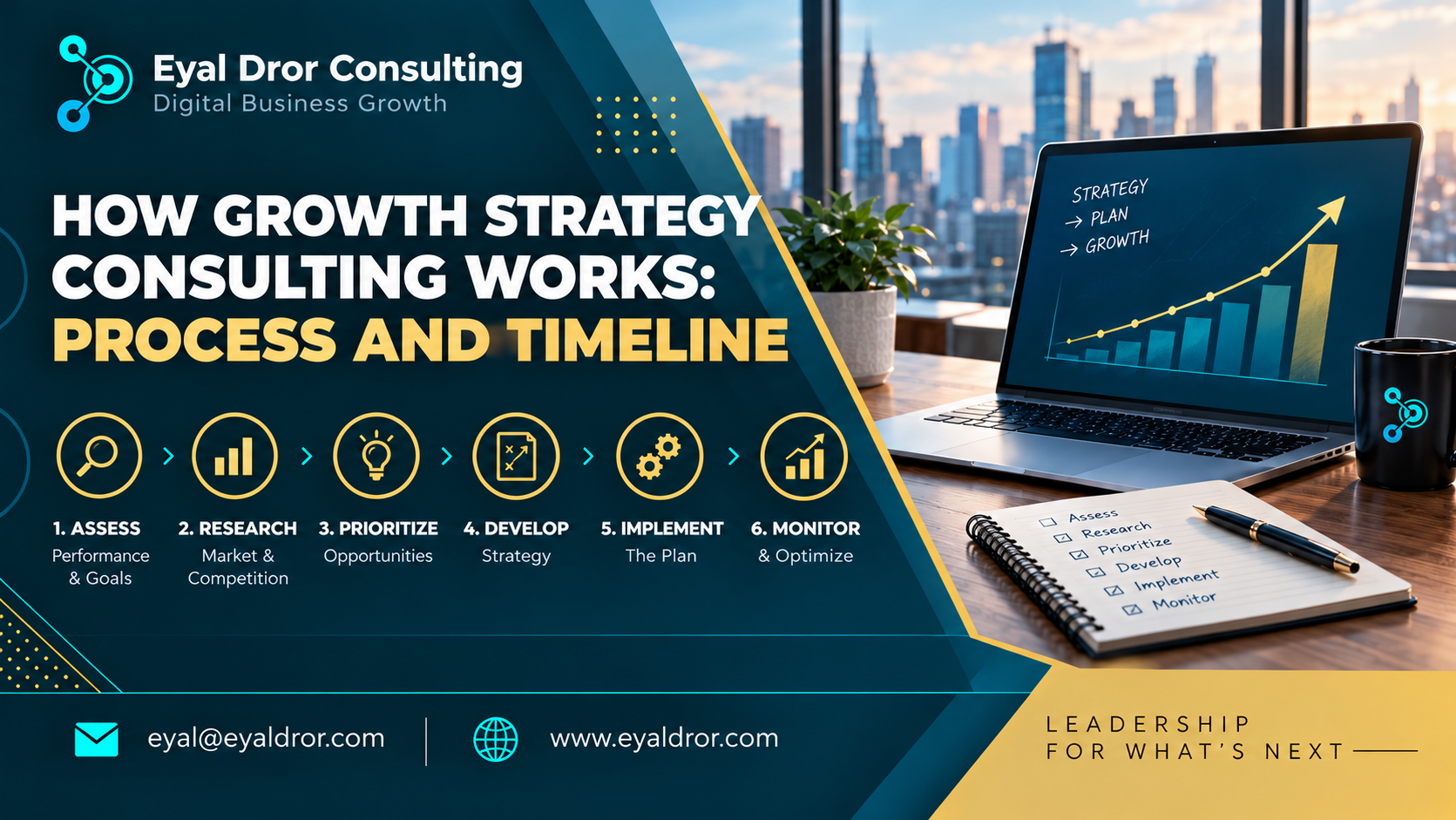
Growth Strategy Consulting refers to external help that finds out where the next growth of your business comes from and develops a strategy to capitalize on it. The use of growth strategy consulting helps businesses identify opportunities that are not visible from within and removes obstacles that prevent growth.
The process follows a clear sequence: assess where you are, research the market, prioritize opportunities, build the strategy, implement it and measure the results. How long each step takes varies with your business goals, complexity and available resources. This guide walks through each step and gives an illustrative timeline so you know what to expect.
What Is Growth Strategy Consulting?
Growth strategy consulting helps a business plan and achieve growth in a structured way. Good growth consulting evaluates four things together: market opportunities, current business performance, the competition and your operational capabilities. Ignore any one and the plan tends to fail.
The output is a business growth strategy, which connects your growth objectives with actionable priorities. It tells you what to do first, who owns it and how you’ll know it is working.
How Growth Strategy Consulting Works: Step-by-Step Process
Step 1: Assess Business Performance and Goals
Every engagement begins with a sincere assessment of your situation. This means checking on the current performance, revenue trends, strengths and challenges.
Then you set business goals and pinpoint what’s inhibiting growth. Last, but not least, you set target metrics and key performance indicators (KPIs) and measure progress from a starting point rather than a feeling.
Step 2: Conduct Market and Competitive Research
Once the inner image has been made clear, the spotlight shifts to the external. You study target customers, market demand and the trends in the industry, you examine the competition and seek out potential gaps.
The goal is to see where you can differentiate and expand.
Step 3: Identify and Prioritize Growth Opportunities
Most businesses have more ideas than capacity. This step outlines the actual options, including market expansion, new offerings, customer acquisition and revenue optimization.
The impact, feasibility, cost and risk are compared with each opportunity. The initiatives are then ranked according to your aims and the resources available.
Step 4: Develop a Business Growth Strategy
The analysis then turns into a plan. You set strategic priorities and measurable growth goals and set up positioning, customer segments and revenue opportunities.
The plan ends in an actionable roadmap, with timelines, responsibilities and KPIs for each initiative.
Step 5: Implement the Growth Plan
A strategy is worth nothing unless put into action. This step is where recommendations are put into action, resources are allocated and responsibilities are assigned.
It also implies the coordination of marketing, sales, production and any other team that the plan affects, so that they all have the same priorities.
Step 6: Monitor Results and Optimize Performance
Progress is monitored during the plan, as agreed at the outset, using KPIs. Results are compared to targets, and early identification of performance gaps.
This strategy is then adjusted according to the data, customer feedback and shifting market trends.
Growth Strategy Consulting Timeline: What to Expect
Depending on how much your business complex is, volume of data and decision making speed, length of engagement will vary. The following table is an example of a growth strategy project timeline.
| Phase | Illustrative timeline |
| Business assessment | Week 1 |
| Market and competitive research | Weeks 1 to 2 |
| Opportunity prioritization | Weeks 2 to 3 |
| Strategy development | Weeks 3 to 4 |
| Implementation planning | Weeks 4 to 5 |
| Monitoring and optimization | Ongoing |
Note: This is an illustrative timeline, not a fixed schedule. Actual times are dependent on the project scope, availability of data, level of stakeholder engagement and implementation needs.
What Factors Affect the Growth Consulting Timeline?
Five factors do most of the work in stretching or shortening a project:
- Business size and organizational complexity. More teams, products and markets mean more to assess.
- Availability and quality of data. Clean, accessible business and market data speeds everything up.
- Number of opportunities being evaluated. A longer list takes longer to compare.
- Stakeholder alignment and decision-making speed. Slow or divided decisions delay prioritization.
- Scope of implementation and ongoing support. Hands-on execution and continued support extend the engagement.
How to Measure the Success of a Growth Strategy
Success should be measured against the KPIs you set in Step 1. Four areas cover most cases:
- Revenue growth and profitability. Is the business growing, and is it making money doing it?
- Customer acquisition, conversion and retention. Are you winning, converting and keeping customers more effectively?
- Market expansion and customer lifetime value. Where relevant, are you reaching new segments and increasing the value of each customer?
- Progress against strategic goals. Are initiatives hitting their agreed milestones and KPIs?
How Eyal Dror Supports Business Growth Strategy
Eyal Dror helps businesses evaluate opportunities and turn them into actionable growth plans. The work covers the full process above, from assessment through measurement.
You can see how it works in practice on the Growth Strategy Consulting service page. If you’re deciding whether it’s right for you, read about the benefits of growth strategy consulting first.
When you’re ready, explore Eyal Dror’s consulting support and start with a conversation about where your growth is stuck.
Frequently Asked Questions
1. How Does Growth Strategy Consulting Work?
Growth strategy consulting works in stages. A consultant evaluates your performance and objectives, performs market research, prioritizes opportunities, creates strategy and roadmap, assists to implement the strategy, and then monitors outcomes based on agreed KPIs.
2. How Long Does a Growth Strategy Consulting Project Take?
It varies. A sample project takes approximately 4 to 5 weeks to assess and plan for its implementation, with continuous monitoring thereafter. The actual time will vary depending on the scope, availability of data, stakeholders’ involvement and implementation requirements, and thus, a more complex business may take longer.
3. What Are the Main Steps in Developing a Business Growth Strategy?
The key activities include measuring performance and goals, market and competitor analysis, opportunity identification and prioritization, creation of the roadmap and strategy, execution and plan, and results tracking.
4. What Factors Influence the Growth Consulting Timeline?
They include the size and complexity of the business, the quality and availability of data, how many opportunities they evaluate, how much consensus there is amongst stakeholders and how fast they make decisions, and the extent of implementation and support.
5. When Should a Business Hire a Growth Strategy Consultant?
Consider one when growth has stalled, when leaders disagree on the cause, when you’re weighing several growth options without a way to compare them, or when nobody has looked at the whole business at once. An outside view helps most when internal teams each see only their own part.
6. How Do You Measure the Results of Growth Strategy Consulting?
Compare against the KPIs and baselines established in the beginning of the year. These are usually increases in revenue, profitability, customer acquisition, conversion rate, retention rate, market expansion and customer lifetime value. Check towards the strategic objectives and milestones in your roadmap too.
