
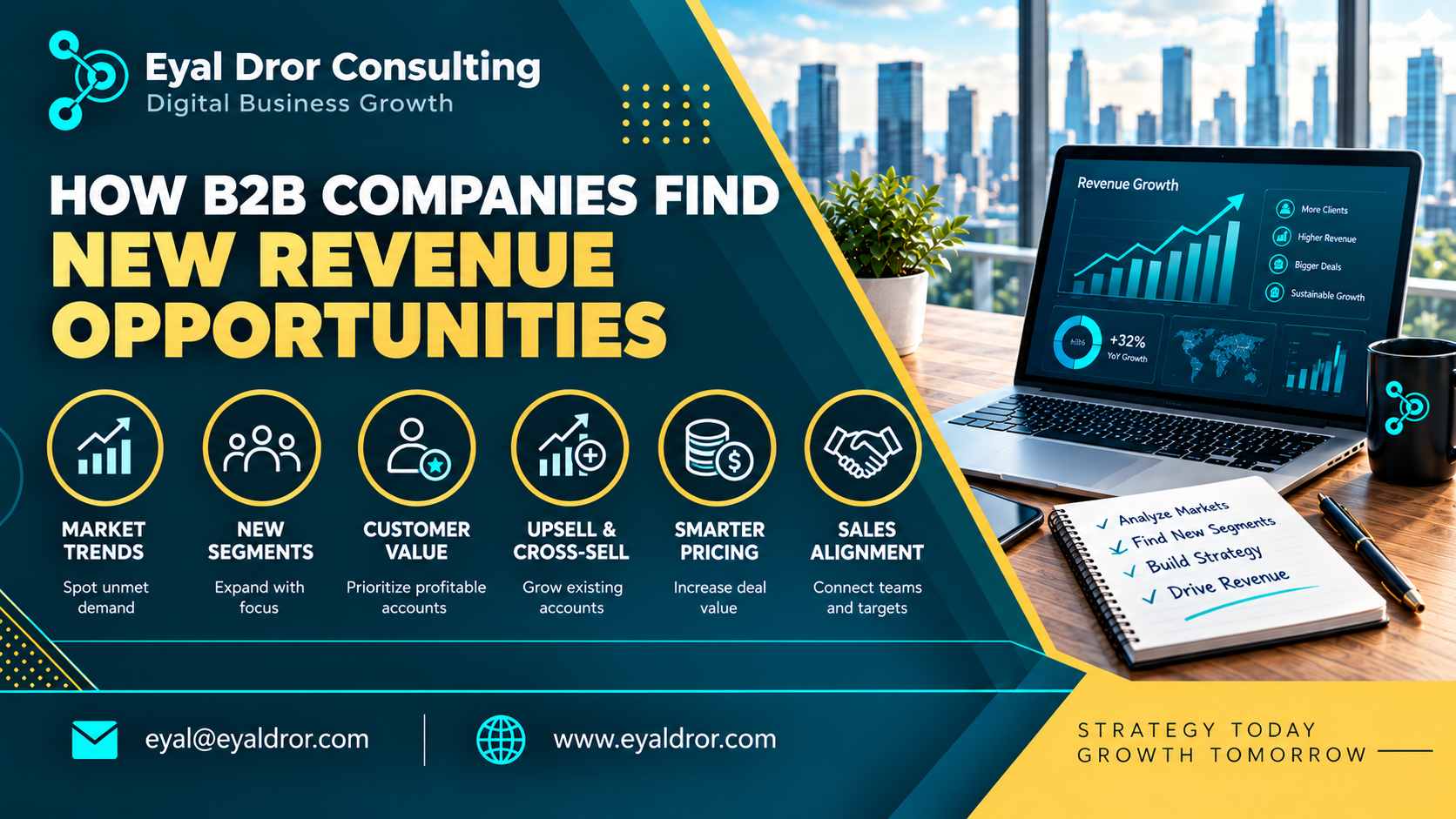
Most B2B companies don’t lack growth ideas. They lack clarity about which ideas deserve investment. Growth strategy consulting for B2B companies turns scattered possibilities into a ranked, measurable plan by applying suitable revenue growth strategies.
What Is Growth Strategy Consulting for B2B Companies?
Growth strategy consulting helps a company decide where future revenue should come from, evaluate the available opportunities, and build a prioritized roadmap to capture them profitably. A consultant combines outside-in analysis (market trends, competitors, unmet needs) with inside-out analysis (customer data, margins, win and loss patterns) to find the gaps where new revenue hides.
Traditional business consulting covers a broad range of operational or organizational problems. Growth Strategy Consulting is narrower and more commercial: where will additional profitable revenue come from, and what will it take to capture it? See Eyal Dror’s Growth Strategy Consulting service for how this work is structured.
Why B2B Companies Struggle to Identify New Revenue Opportunities
Limited Visibility Into Market Demand and Customer Needs
Many companies rely on anecdotes from sales calls and a few large accounts. This is the reason why segment size, growth and buyer needs stay unclear.
Overdependence on Existing Customers and Revenue Streams
It is natural for businesses to optimise what already works. Well, it keeps the core healthy but also hides new segments, offerings and revenue models.
Inefficient Sales and Marketing Alignment
When sales and marketing teams define a good lead differently, it makes it harder to differentiate between demand problem and conversion problem.
Lack of Competitive and Market Intelligence
Where there is no systematic tracking, the company may not identify the right competitor positioning or pricing. They are generally noticed after deals are lost.
Difficulty Prioritizing High-Growth Business Opportunities
The organisation must follow a shared ranking method. It helps in valuing the opportunity with the best economics rather than going for the loudest idea always.
How Growth Strategy Consulting Identifies New B2B Revenue Opportunities
1. Analyzing Market Trends and Untapped Customer Segments
This includes evaluating industry trends, demand and competitor positioning. Through this, you may find underserved segments and emerging opportunities easily.
2. Developing a Data-Driven Market Expansion Strategy
To identify the new B2B revenue opportunity, it is important to assess new geographies, verticals and customer categories. All of these should be done on the basis of attractiveness, entry barriers and growth potential. Also, test whether you have a credible right to win.
3. Improving Customer Segmentation and Ideal Customer Profiles
This includes analyzing profitability, buying behavior and lifetime value. This clearly shows which accounts are worth pursuing. When you refine your ICP, it lifts growth faster than adding top-of-funnel volume.
4. Identifying Upselling and Cross-Selling Opportunities
This is the most basic and important step of the process. Mostly, the existing customers are the cheapest source of new revenue. So it is essential to analyse the purchase pattern to reveal upselling and cross-selling opportunities.
5. Optimizing Pricing and Revenue Models
You may easily increase average deal size and revenue per customer with the help of value-based pricing, subscriptions and service packaging. And the good thing is that it is not necessary to change the product for that.
6. Strengthening Sales and Marketing Alignment
Finding new revenue opportunities becomes easier when you connect demand generation, sales process and revenue targets. This improves qualification, conversion and predictability. For the systems side, see Revenue Operations Consulting.
Key B2B Growth Strategies That Create Sustainable Revenue
| Strategy | Revenue Potential | Investment | Best Suited For |
| Market penetration and customer acquisition | Moderate | Low to moderate | Room left in the core market |
| Geographic and industry expansion | Moderate to high | Moderate to high | Core market nearing saturation |
| Product and service diversification | High | Moderate to high | Strong relationships and clear unmet needs |
| Strategic partnerships and channels | Moderate to high | Low to moderate | Distribution is the constraint |
| Retention and account expansion | Moderate | Low | Large base with under-penetrated accounts |
Market penetration is the lowest-risk path.
Expansion extends growth when the core tightens, ideally into adjacent markets where your reputation transfers.
Diversification raises revenue per customer but should be validated with existing customers first.
Partnerships open access you couldn’t reach alone.
Retention and account expansion is often the highest-return move available.
How to Build a Data-Driven B2B Business Growth Strategy
Here is the five-step process to build a reliable B2B business growth strategy:
Step 1: Assess Current Revenue Performance and Business Objectives
Document where revenue comes from by segment, product, channel and region, and set clear targets.
Step 2: Conduct Market Research and Competitive Analysis
Combine external data with customer interviews and win/loss analysis. This helps in finding unmet demand and competitor weaknesses.
Step 3: Identify and Score Potential Revenue Opportunities
Score every opportunity on the same criteria. It includes attractiveness, demand, right to win, economics, capability fit, investment and risk.
Step 4: Develop a Growth Roadmap With Measurable KPIs
You can turn top-scoring opportunities into a roadmap with owners, milestones, budgets and KPIs. New market entry or a product launch also needs a defined customer, positioning, pricing and sales motion. Go-to-Market Strategy Consulting covers how that plan supports expansion and launches.
Step 5: Test Growth Initiatives and Optimize Based on Results
Identify the most promising initiatives. Measure them against KPIs, then scale, adjust or stop.
Important KPIs to Measure B2B Revenue Growth
| KPI | How It Is Calculated | Why It Matters |
| Revenue growth rate and ARR | (Current revenue minus prior revenue) divided by prior revenue | Shows whether and how fast the business is growing |
| Customer acquisition cost (CAC) | Sales and marketing spend divided by new customers | Shows whether growth is efficient |
| Customer lifetime value (CLV) | Average revenue per customer × margin × expected lifespan | Guides how much to spend acquiring a customer type |
| Pipeline velocity and conversion | Opportunities × win rate × average deal size, divided by sales cycle length | Highlights stalls and funnel leaks |
| Net revenue retention (NRR) | (Starting revenue + expansion − churn and contraction) divided by starting revenue | Shows whether existing accounts grow or shrink |
| ROI from growth initiatives | (Gain minus cost) divided by cost | Shows which bets deserve more investment |
When Should a B2B Company Hire a Growth Strategy Consultant?
- Revenue is stagnant even as sales efforts have been increased.
- It costs more money to acquire customers.
- The organization wants to explore new markets or industry sectors.
- Products/services already being offered need to generate more revenue.
- A clear growth plan is needed by leadership.
To see how efficient operations support scalable revenue growth, you can read more on What Does Revenue Operations Consulting Include?
How Eyal Dror Helps B2B Companies Unlock New Revenue Opportunities
Eyal works with B2B leadership teams as an operator and advisor. This creates a combination of strategy with practical execution:
- Evaluating current performance and growth barriers.
- Identifying profitable segments and revenue opportunities.
- Developing customized growth and market expansion strategies.
- Aligning sales, marketing and revenue operations.
- Building measurable growth roadmaps.
Explore how Growth Strategy Consulting can help your B2B company identify new revenue opportunities and build a scalable growth strategy.
Frequently Asked Questions
What is growth strategy consulting for B2B companies?
It is used to determine the source of future revenue, compare potential projects from multiple markets, customers, products and channels, and create a prioritized roadmap with quantifiable KPIs.
How do growth strategy consultants identify new revenue opportunities?
They conduct market and competitor research, analyse your customer, pricing and sales data to identify underserved market segments, pricing and sales opportunities for expansion, and calculate the economics, fit and risk of each opportunity to arrive at a score.
What are the most effective B2B growth strategies?
It depends on the business. The main options are market penetration, geographic and industry expansion, diversification, partnerships, and account expansion. Many companies pursue a focused combination.
How can B2B companies identify untapped market opportunities?
Study market trends, weaknesses of your competitors, and your customers’ most profitable segments. Interview and conduct small pilots in the neighboring segments before a large investment. Finally, test the market.
What is the difference between growth strategy consulting and revenue operations consulting?
Growth strategy decides where growth should come from. Revenue operations makes the revenue engine, including processes, data, CRM and technology, run consistently and measurably.
How long does it take to see results from a B2B growth strategy?
Pricing adjustments, account growth, and other quick wins can yield results within a couple of quarters. It takes a longer time to expand the market and introduce new products. Initially establishing KPIs and a measurement window helps govern the progress.
Conclusion
New revenue opportunities surface when honest market research, sharper segmentation, smarter pricing and disciplined planning are combined and ranked against consistent criteria. The strategies that last are measurable, tested before scaling, and owned by accountable people.
If growth has plateaued or you’re weighing where to invest next, book a consultation to explore Eyal Dror’s Growth Strategy Consulting and build a strategy designed for sustainable results.
