
Revenue operations get messier as a B2B SaaS company scales. Teams grow, CRM data drifts, pipeline stages mean different things to different people and handoffs start to leak. Suddenly nobody can explain why revenue looks the way it does, let alone forecast it.
A revenue operations audit is a structured look at the systems, processes, data, metrics and ownership behind the whole customer lifecycle. If you’d rather have expert help running one, Revenue Operations Consulting is built for exactly that. This revenue operations audit checklist helps you find bottlenecks yourself and turn them into an improvement plan.
What Is a Revenue Operations Audit?
A RevOps audit is a systematic review of how you acquire, convert, retain and expand customers. It covers the entire revenue lifecycle, not just sales performance.
What Does a RevOps Audit Evaluate?
It looks at people, processes, technology, data quality, funnel performance, forecasting and customer lifecycle management. In other words, the whole B2B SaaS revenue operations framework.
Why Scaling SaaS Companies Need Regular RevOps Audits
Here’s the thing: processes that worked at 10 customers can quietly break at 100. More volume, bigger teams, new integrations and complex revenue models expose weaknesses that used to hide.
When Should a B2B SaaS Company Conduct a RevOps Audit?
Signs Your Revenue Operations Need Attention
Watch for unreliable forecasts, poor lead-to-opportunity conversion, inconsistent CRM data, falling win rates, lengthening sales cycles and customer success reporting that doesn’t connect to the rest.
Growth Milestones That Make an Audit Valuable
Moving beyond founder-led sales, adding specialised revenue teams, entering new markets or preparing for major expansion are all good moments to look under the hood.
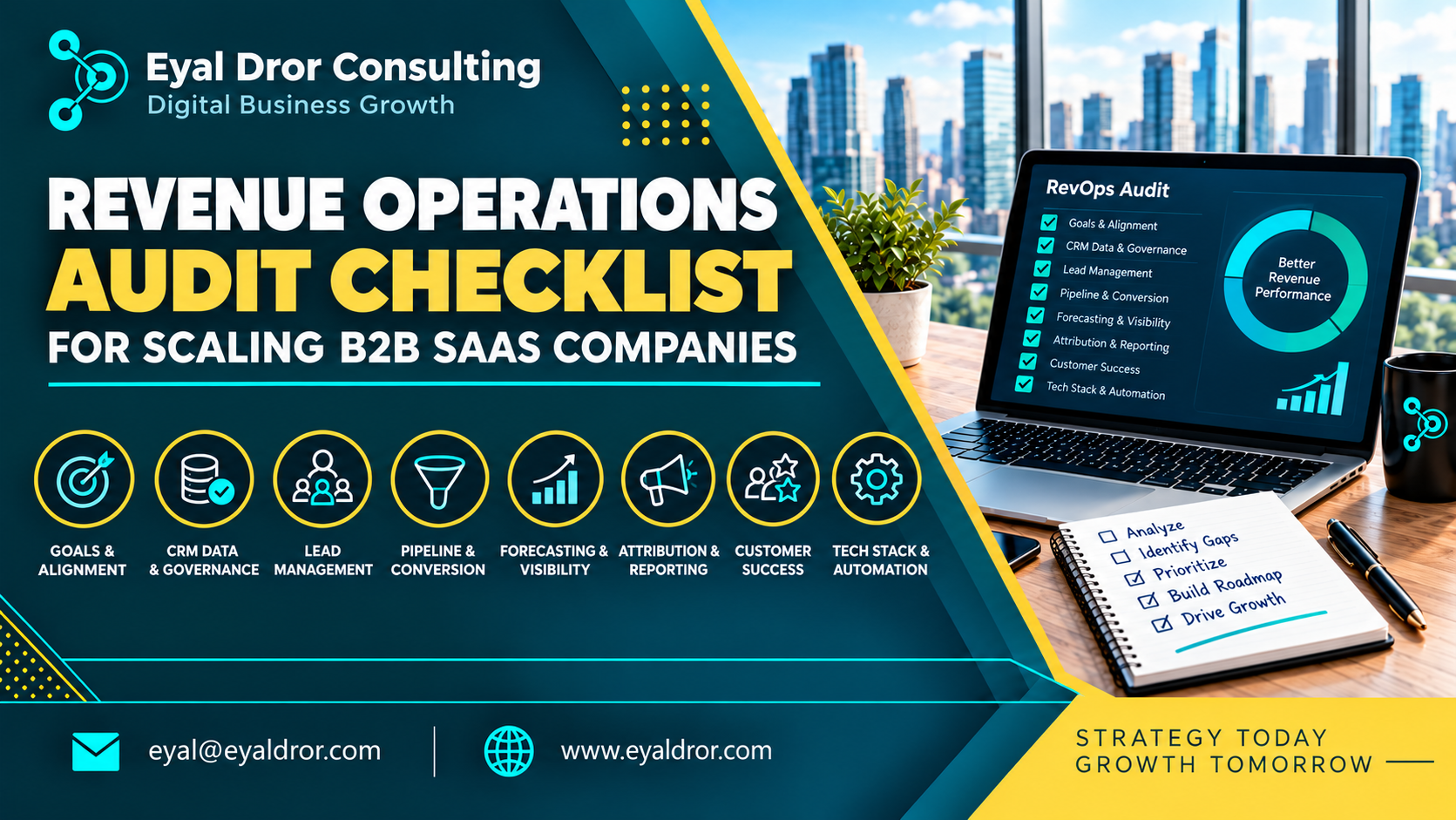
Revenue Operations Audit Checklist: 8 Areas to Review
What most people miss is that an audit runs on evidence, not opinions. Screenshots, reports and documented definitions beat “I think so”.
1. Revenue Goals and Cross-Functional Alignment
- Are revenue targets clearly defined?
- Do teams use consistent KPI definitions?
- Is each lifecycle stage owned?
- Are handoffs documented?
- Are performance reviews regular?
Conflicting goals create friction and hide revenue leakage.
2. CRM Data Quality and Governance
This is your CRM audit checklist.
- Are duplicate and outdated records controlled?
- Are required fields completed consistently?
- Are lifecycle stages standardised?
- Are contacts and companies linked correctly?
- Does someone own data governance?
Poor data quality wrecks reporting, segmentation, routing and forecasting.
3. Lead Management and Qualification
- Are MQL and SQL definitions documented?
- Are qualification criteria consistent?
- Do routing rules work reliably?
- Are response-time expectations set?
- Is there a sales-marketing feedback loop?
Weak qualification and slow follow-up leak funnel value.
4. Sales Pipeline and Conversion Performance
Run a sales pipeline audit here. For more on this, see sales funnel optimization.
- Are stages clearly defined?
- Do stages have entry and exit criteria?
- Are stalled opportunities reviewed?
- Are stage-by-stage conversion rates measured?
- Are win/loss reasons recorded?
5. Revenue Forecasting and Pipeline Visibility
- Is the forecasting methodology documented?
- Are close dates maintained?
- Are forecast categories applied consistently?
- Is pipeline coverage monitored?
- Are forecasts compared with actuals?
Subjective assumptions and messy opportunity data erode leadership confidence in revenue forecasting accuracy.
6. Marketing Attribution and Revenue Reporting
- Are attribution definitions documented?
- Are lead-source fields reliable?
- Can campaigns be tied to opportunities?
- Do dashboards share data definitions?
- Can CRM and finance reporting be reconciled?
Attribution is useful, but no single model captures every marketing contribution.
7. Customer Success, Retention and Expansion
- Are sales-to-CS handoffs documented?
- Are renewal dates and contract values accurate?
- Are churn reasons classified consistently?
- Is net revenue retention tracked?
- Are expansion opportunities visible?
A SaaS audit can’t stop at closed-won. Renewals, churn and expansion are where the revenue compounds.
8. Revenue Technology Stack and Automation
- Does every tool have an owner?
- Are integrations monitored for errors?
- Are key workflows documented?
- Are duplicate tools or unused licences identified?
- Are automations tested regularly?
Fragmented integrations add cost and weaken efficiency.
Which KPIs Should Be Included in a RevOps Audit?
Good RevOps KPIs quantify performance and expose bottlenecks.
Acquisition and pipeline: lead-to-opportunity conversion, win rate, sales cycle length, pipeline velocity, pipeline coverage and customer acquisition cost (CAC).
Revenue and retention: ARR, MRR, net revenue retention, gross revenue retention, churn and lifetime value (LTV).
| Metric | Calculation | Source | Owner | Review |
| Win rate | Won deals / total closed deals | CRM | Sales | Monthly |
| NRR | Revenue from existing customers, including expansion, minus churn and contraction, over starting revenue | Billing | CS | Quarterly |
| CAC | Acquisition spend / new customers | Finance and CRM | RevOps | Quarterly |
Avoid universal benchmarks. The right numbers depend on customer segment, contract value, sales motion and maturity.
How to Score and Prioritise Your RevOps Audit Findings
Create a Simple RevOps Audit Scoring System
Score each area from 0 to 3 and record evidence beside the rating.
| Score | Meaning |
| 0 | Not defined or unavailable |
| 1 | Defined informally, inconsistent execution |
| 2 | Documented and mostly followed |
| 3 | Measured, governed and regularly improved |
Prioritise Issues by Business Impact and Implementation Effort
Rank findings by revenue impact, operational risk, effort and dependencies. High impact and low effort goes first.
Identify Quick Wins and Structural Improvements
Quick wins include cleaning mandatory CRM fields. Structural changes include redesigning lifecycle stages or forecasting architecture. Do both, but sequence them.
How to Build a 90-Day RevOps Improvement Roadmap
Days 1 to 30: Establish the Baseline
Document findings, validate data, resolve critical reporting discrepancies and assign owners.
Days 31 to 60: Fix Revenue Process Bottlenecks
Tackle lead routing, handoffs, stage definitions, reporting and automation problems.
Days 61 to 90: Implement Governance and Measure Progress
Introduce recurring KPI reviews, documented procedures, dashboard ownership and accountability. Measure against your original baseline, not gut feel.
Should You Run a RevOps Audit Internally or Hire a Consultant?
Learn what revenue operations consulting includes before deciding.
When an Internal Audit Makes Sense
It works when you have reliable data access, clear process ownership, analytical capacity and cross-functional expertise.
When External RevOps Expertise Can Help
An independent view helps when teams disagree about priorities, forecasts can’t be trusted, systems are fragmented or nobody leads RevOps. For a deeper comparison, read Head of RevOps vs RevOps consultant. If you need ongoing executive-level ownership after the audit, Fractional CRO services can fill that gap.
Revenue Operations Audit Checklist FAQs
What Should Be Included in a Revenue Operations Audit?
Goals and alignment, CRM data, lead management, pipeline, forecasting, attribution, customer success and the tech stack, plus the KPIs that measure them.
How Often Should a B2B SaaS Company Conduct a RevOps Audit?
Annually is common, with extra reviews at growth milestones or when forecasts and data start to drift.
What Is the Difference Between a CRM Audit and a RevOps Audit?
A CRM audit checks data and configuration. A RevOps audit covers the CRM plus processes, ownership, metrics and the whole customer lifecycle.
Which SaaS Metrics Matter Most During a RevOps Audit?
Conversion rates, win rate, cycle length, CAC, ARR, NRR, GRR and churn. Prioritise those that match your sales motion.
Who Should Own the Revenue Operations Audit?
Usually a RevOps leader or a senior revenue executive, with input from sales, marketing, customer success and finance.
How Long Does a RevOps Audit Usually Take?
It varies with company size, data access and complexity, from a couple of weeks to a couple of months.
Final Thoughts: Turning Your RevOps Audit Into Scalable Growth
A structured audit exposes revenue leakage, improves data reliability and tightens coordination across the customer lifecycle. But the value isn’t in finishing the checklist. It’s in implementing fixes and measuring the results. If you’d like help turning findings into a scalable operating model, professional RevOps support is worth exploring.
