
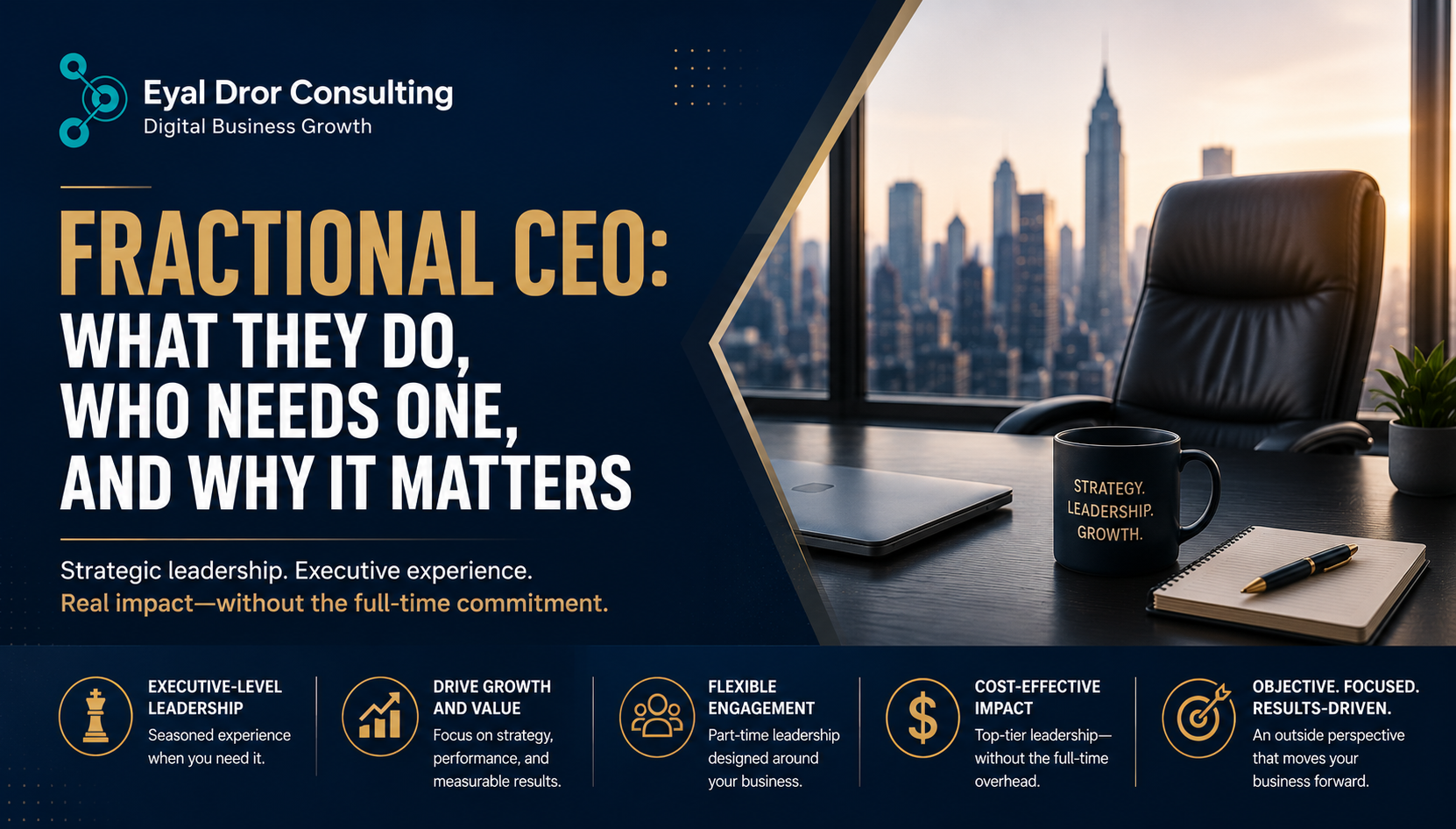
The term “fractional” has become one of the most significant vocabulary in contemporary business leadership in a way. While you’ve probably heard it attached to titles such as fractional CMO, CFO or COO, fractional CEO has a different meaning altogether, and you might need to rethink your approach to hiring executive talent.
Let’s dissect the meaning of the word, what the job entails on a day-to-day basis, and how it’s becoming part of the way business is done more and more.
Breaking Down the Term
“Fractional” is just part time or partial. A fractional CEO is a chief executive officer that takes a percentage of his time, a “fraction” of it, to devote to your company, instead of working in your company full-time.
In practice, this is typically defined as a certain number of days to work each week or a certain number of hours each month, paid as a retainer or contract instead of a standard salary and benefits package. The fractional CEO may be managing two or three or even four different businesses at once, giving each business a specific portion of his or her time and attention.
Obviously, the “meaning” of the role is not contained within the schedule. A fractional CEO does not mean a downgrade or lesser version of a full-time CEO. Most fractional executives are experienced leaders, frequently former business founders, C-suite experts or people with an established background of building companies, and have chosen to pursue a career in a portfolio rather than a single, full-time position. They’re as savvy in their judgment and experience, only they do it differently.
The Role, Explained: What Does a Fractional CEO Actually Do?
The essence of fractional CEO is the same as a traditional CEO, strategy, leadership and accountability, but in a more specific or limited scope. Common responsibilities include:
Strategic direction. Establishing or clarifying the organization’s vision, growth plans and priorities for the coming months or years.
Leadership and team management. Training managers and leaders in the department, coaching current leaders, and at times reorganizing teams to better serve company objectives.
Financial oversight. Working closely with the finance teams on budgeting, forecasting, fundraising strategy or preparing the business for acquisition or investment.
Board and stakeholder communication. Reporting to the board, investors or ownership group regarding progress, risk and opportunities.
Operational problem-solving. Identifying the blocking points, inefficiencies and cultural problems and making successful, lasting changes.
Building for continuity. But most of all, a successful fractional CEO doesn’t only make choices, they create systems, processes and leadership that sustain beyond their own tenure.
The last one is an important one to mention. A fractional CEO’s time is limited with any particular organization and a lot of the benefit is that the organization could be left stronger and more independent than when they joined, rather than depending on his or her continued presence.
Why the Role Exists: The Business Logic Behind It
Why the role is needed: The Business Logic behind it.
The fractional CEO position isn’t just a trendy label but a genuine business challenge, as there is often a disconnect between the leadership a business requires and the one that they would be able to afford and/or justify on a full-time basis.
Think of a company that is in the middle range of startup companies with $3 – 5 million in annual revenue. While it may require C-suite strategic thinking, it doesn’t have to be 40 hours per week of that kind of thinking, and it certainly can’t afford the salary, bonus and equity that that kind of a CEO would command. It’s an elegant solution to this mismatch: the company gains executive-level thinking at a scale and cost that it can afford.
That’s also why fractional leadership is often used in certain business scenarios:
Post-funding growth phases: When a company needs to professionalize its operations quickly
Founder transitions: When a founder wants to step back from day-to-day operations without fully exiting
Pre-acquisition preparation: When a business needs to tighten its operations and financials before a sale
Leadership gaps: While a company searches for the right permanent hire
Fractional CEO vs. Other Related Roles
The terminology in this area can become confusing, so it’s best to draw some lines:
- A fractional CEO works part-time on an ongoing or renewable basis.They hold real executive authority.
- An interim CEO works full-time but only for a fixed temporary period to bridge a leadership gap.
- A business consultant or advisor offers recommendations and strategic input. But they do not hold direct decision-making authority or day-to-day accountability for results.
- A board member or advisor provides high-level guidance and oversight but isn’t embedded in daily operations at all.
It is important to know these differences as it can influence expectations, contracts, and most importantly, what authority a company is willing to grant.
How to Know If You Need One
A fractional CEO tends to make sense when there’s a real strategic or operational need in a company that cannot afford a full-time executive or does not have the long-term certainty or scale to justify the investment. Some indicators that it may be a good choice are:
- Things are growing quickly and faster than they are being led.
- A founder that has a vision, product or sales mindset and not an operations one.
- A fundraising round, acquisition or significant pivot.
- Objective, senior level insight needed when change is happening.
If your company identifies with any of the above, a fractional CEO can provide valuable leadership without the financial and organizational burden of a permanent hiring.
But it’s important to note that it’s not just about the cost savings. Even companies that have the money for a full-time CEO are still opting for the fractional path in order to have a more focused and disciplined interaction. Because a fractional CEO has limited hours on the calendar, and they’re much more likely to be in the right place at the right time, they’re often more able to focus on the highest-leverage work they can get done and may not be drawn into all of the day-to-day noise that could fill up a full-time executive’s time.
That is enough for some businesses to get more value from than they would from the additional hours.
Setting a Fractional CEO Up for Success
The scope is best defined from the start of bringing on a fractional CEO. It is useful to establish, before the engagement, the following:
- The outcomes or milestones that the engagement will help the organization achieve
- The hours/days per week that a CEO will devote to the business.
- Who else within the team needs to be involved and how decisions will be communicated
- The definition of success at the end of the engagement, and if it is to be repeated
Sometimes, whether it’s having expectations of full-time engagement when you’re only on a part-time basis or thinking that you can get much more done in a focused engagement, there are mismatched expectations set. Just a bit of clarity will help.
Bringing the Right Leadership – and the Right Visibility
The next step is to actually comprehend the meaning behind the ‘fractional CEO’ designation. The real value is in finding the right person, structuring the engagement properly and then aligning the brand and marketing presence with the direction that leadership is taking the company.
As a digital marketing firm, we work alongside leadership teams, fractional, interim, or full-time, to make sure your company’s growth strategy is matched by a marketing presence built to support it. Visit eyaldror.com today to learn how we can help turn strong leadership into visible, measurable growth.

Leave a Comment