
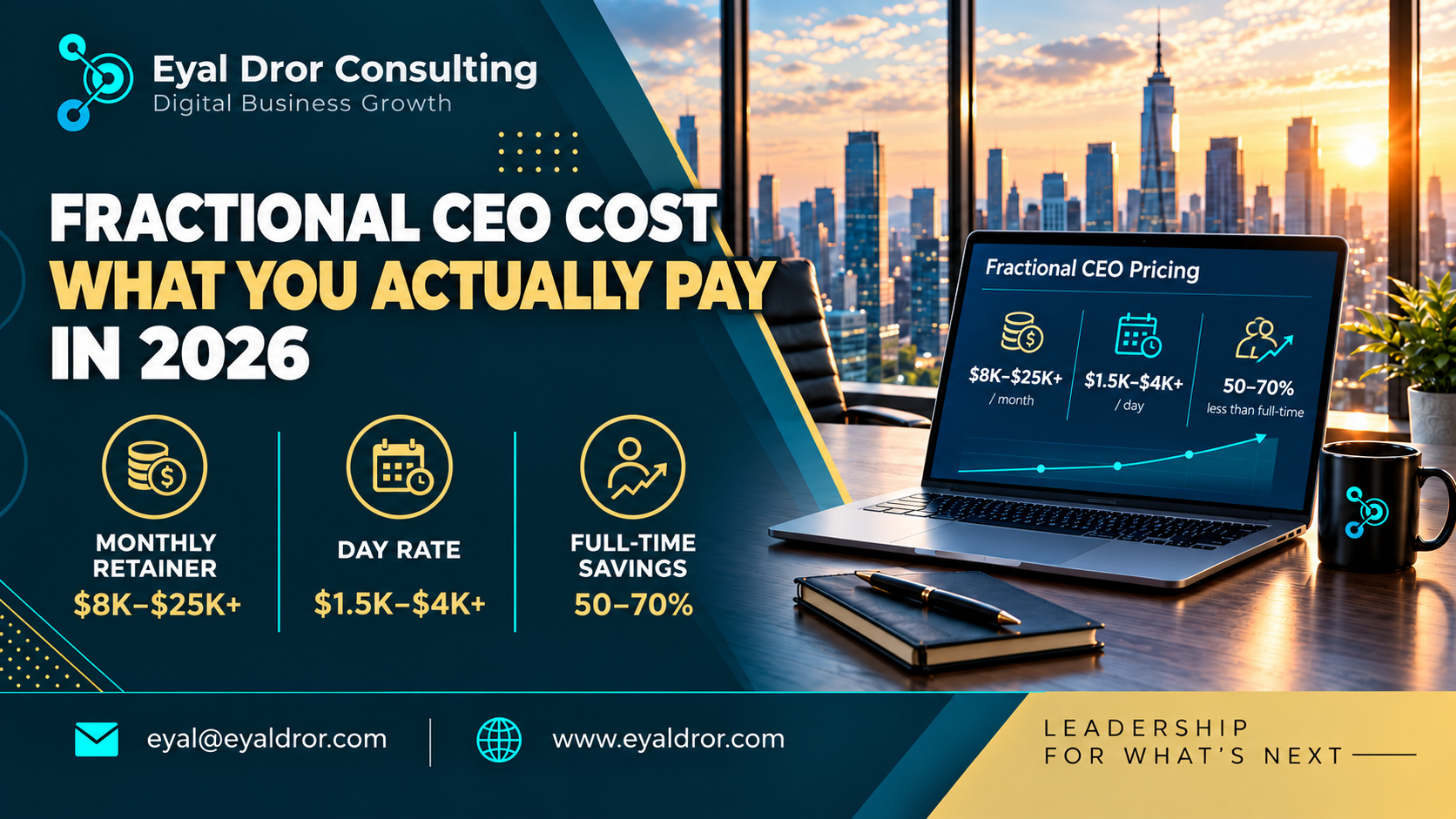
“How much does this actually cost?” is usually the second question after “what is a fractional CEO,” and it’s the harder one to answer well, because quoted numbers online swing wildly, anywhere from a few thousand dollars a month to well over $25,000. Understanding fractional CEO cost in 2026 means understanding what’s actually driving that range, not just picking a number in the middle. Here’s a real breakdown of how pricing works, what the different engagement structures look like, and what actually moves the price up or down.
What Is a Fractional CEO
A fractional CEO is a highly senior executive who assumes the strategic leadership of a full CEO, making decisions, holding other leaders accountable, representing the company to investors or partners, and more, but on a contract basis, not as a full-time employee. The engagements usually last anywhere from 1 day to 4 days a week, and are typically a retainer with a definite period of engagement or a retainer that has no end date, rather than regular employment. The job’s purpose is to provide young firms with real C-level experience without the expense, obligation or time frame of a permanent executive search.
How Fractional CEO Pricing Works
Fractional CEO pricing is built around time commitment and scope, not a flat industry-wide rate card. Most fractional executives price their engagement based on the number of days or hours committed per week, then layer in adjustments for company complexity, industry, and the executive’s own experience level. Based on current 2026 market data, average fractional CEO hourly rates sit somewhere in the $150–$350/hour range, with a commonly cited market average around $200/hour for experienced operators. A typical engagement is scoped at somewhere close to 16 hours a week: meaningful, ongoing involvement, but well short of a full-time role.
Because most engagements run on a retainer rather than a pure hourly bill, the practical number most businesses actually budget for is a monthly figure, not an hourly one, which is where the different engagement models come in.
Fractional CEO Engagement Models: Hourly, Day Rate, Retainer and Equity
There isn’t one standard way fractional CEO relationships get priced. In practice, four fractional CEO engagement models cover most of the market:
- Hourly billing. Payment tracked and invoiced against actual hours worked. This model is less common for ongoing CEO-level engagements and shows up more often for narrow, well-defined advisory work rather than embedded leadership.
- Day rate. A fixed fee per working day, commonly falling somewhere in the $1,500–$4,000+ range depending on seniority and industry, typically used for project-based or short, defined engagements rather than long-term leadership relationships.
- Monthly retainer. The dominant structure in this market. A fixed monthly fee, typically ranging from around $8,000 to $25,000+ depending on days per week and experience level, covering ongoing strategic leadership rather than metered hours. Retainers usually start with an initial three-month term before shifting to an open-ended or month-to-month arrangement.
- Equity or hybrid compensation. Some engagements, particularly with earlier-stage or cash-constrained companies, supplement a lower cash retainer with equity, aligning the fractional CEO’s incentives with long-term company performance rather than relying purely on cash compensation.
Retainer remains the most common structure specifically because strategic leadership doesn’t happen in clean, hourly blocks, much like other fractional C-suite roles, continuity and consistent access tend to matter more than metered time.
Fractional CEO Cost vs a Full-Time CEO Salary
The gap here is big. A full-time C-suite hire in the US typically costs $225k to $350k per year in base salary alone, with loading of benefits, payroll taxes, bonus and equity easily adding another $350k to $500k per year. On top of that base number are the costs and time of recruiting, onboarding and the possibility of a bad executive hire.
At $10k-$15k per month, a fractional retainer CEO is equivalent to about $120k-$180k per year, and that’s before figuring in that a fractional engagement doesn’t share the cost of a long-term severance liability, equity dilution, or the same benefits as a full-time hire. A typical financial driver for companies that require a seat at the table for senior leaders, but aren’t quite ready to or cannot afford to fill that seat with a full-time executive is the amount of money saved from hiring a fractional executive, often estimated at 50–70% of the cost of a full-time executive.
Fractional CEO Cost vs Hiring a Business Consultant
Rates are similar or even higher for consultants charged hourly or for a project, but it’s not really about the rate, it’s about the value you’re getting. A consultant is generally brought on to complete a specific project or conduct an analysis, provides a set of recommendations, and is removed from the picture without having any further responsibility for whether the recommendations are followed or the performance of the business subsequently.
The cost of a fractional CEO is ongoing accountability, someone who is actually involved and on the job, influencing other leaders, and remaining accountable for results throughout the duration of the assignment, rather than handing off a report and walking away. For a business that needs execution and leadership continuity, not just analysis, the fractional CEO’s retainer is buying a fundamentally different kind of engagement, even when the sticker price looks similar to a Strategic Consulting proposal.
What Affects the Price of a Fractional CEO
A handful of factors consistently move the number up or down:
- Days or hours per week. The most direct driver, a one-day-a-week advisory arrangement costs meaningfully less than a three-to-four-day-a-week embedded leadership role.
- Experience and track record. A CEO with multiple successful exits or turnarounds in a specific industry commands a premium over someone earlier in their fractional career.
- Company complexity. More locations, more direct reports, more regulatory complexity, or an approaching fundraise or M&A process all tend to push scope and price upward.
- Industry. Specialized or highly regulated industries (fintech, healthcare, deep tech) often command higher rates than general consumer or services businesses, reflecting the narrower pool of executives with relevant experience.
- Engagement length. Shorter, more urgent engagements sometimes carry a premium over longer-term retainers, since the executive is sacrificing more flexibility to prioritize your business on short notice.
Typical Fractional CEO Rates by Company Stage
Rates tend to cluster in recognizable bands depending on what stage a company is at:
- Early-stage or pre-revenue companies typically engage a fractional CEO for lighter involvement, often one to two days a week, landing in a lower monthly range, sometimes supplemented with equity to offset limited cash flow.
- Growth-stage companies with real revenue and an existing team tend to need two to three days a week, generally falling in the $10,000–$18,000/month range, often tied to a specific growth objective like scaling revenue or professionalizing operations.
- Later-stage or more complex companies enter a fundraise, acquisition or major restructuring in stages, often being more time intensive, which can increase the time they commit to the market to 3-5 days per week, and sometimes the price to $20,000-$25,000+/month.
How to Structure a Fractional CEO Contract
A well-structured engagement usually contains all or a combination of the following: a clear definition of the scope of work and specific deliverables, not just a more general ‘strategic leadership’ description; a clear time commitment on days or hours per week; a clear start date and end date for the engagement, typically three months; a specific measurement of success that is agreed on at the outset, allowing progress to be measured; and an understanding of whether part of the compensation will also be equity-based and an understanding of the vesting terms, if applicable.
These specifics may be documented ahead of the engagement to prevent the most frequent source of conflict in fractional relationships: differing expectations of time, scope and what “success” actually looks like. This is also where working with an experienced operator like Eyal Dror Consulting pays off beyond the leadership itself.
FAQs
How much does a fractional CEO cost per month?
The range of monthly retainers is approximately $8,000 to $25,000+ depending on days per week, company size and experience of the executive, and $10,000-$18,000 for most engagements of two to three days a week.
What is a typical fractional CEO day rate?
The day rates are typically more around $1,500 to $4,000 or above depending on the seniority and industry level and are usually used for shorter project-based engagements and not long term leadership positions.
Do fractional CEOs take equity instead of cash?
Some do, especially in early-stage or cash-constrained companies, usually as some sort of a hybrid arrangement in addition to cash compensation.
Is a fractional CEO cheaper than a full-time CEO?
Yes, often very much so. In fact, a fractional retainer is often 50-70% cheaper on an annual basis when you take into account salary, benefits, equity and recruitment costs.
