
Most businesses don’t fail overnight. They fail slowly, then suddenly. Revenue slips a little each quarter. Margins shrink. Cash flow becomes tighter. Key employees leave. Customer acquisition costs rise while sales conversion falls. Individually, these issues may seem manageable. Together, they create a downward spiral that can threaten the future of the entire company.
The challenge is that many founders and CEOs recognize the warning signs but delay taking decisive action. They hope the next quarter will be better, that a new hire will solve the problem, or that market conditions will improve. Unfortunately, waiting often makes recovery more difficult and expensive.
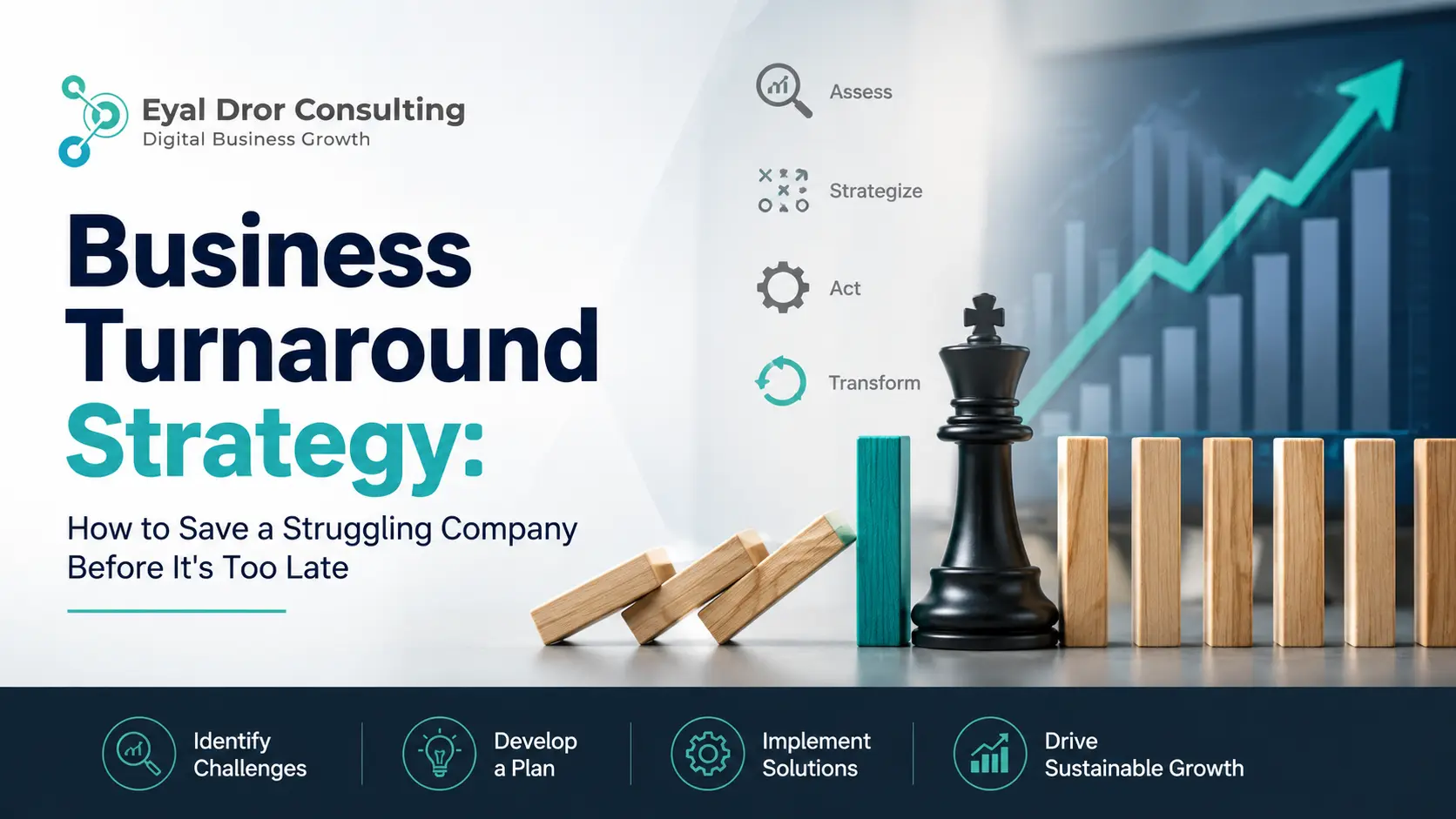
A successful business turnaround strategy Consulting is not about making minor adjustments. It’s about identifying the root causes of decline, stabilizing the business, and implementing a structured plan to restore profitability and growth.
In this article, you’ll learn how to recognize when your company needs a turnaround, the four-phase framework used by experienced operators, and whether you should lead the process yourself or bring in outside expertise before it’s too late.
What Is a Business Turnaround Strategy?
A business turnaround strategy is a structured process designed to stabilize, restructure, and reposition a company that is underperforming or experiencing decline.
Unlike a traditional growth strategy, which focuses on expansion and scaling, a turnaround starts from a position of pain. The priority is not growth at all costs, it is restoring stability, improving performance, and creating a sustainable path forward.
A turnaround may be necessary when a business experiences:
• Stalled or declining revenue
• Shrinking profit margins
• Persistent cash flow problems
• Leadership or organizational dysfunction
• Loss of market share
• Operational inefficiencies
Many leaders view a turnaround as a sign of failure. In reality, it is the opposite.
A company turnaround is a deliberate intervention that acknowledges reality and creates a roadmap for recovery. Some of the most successful businesses in the world have undergone significant restructuring before achieving long-term success. The key is acting early enough to preserve options and avoid crisis-driven decision-making.
Signs Your Company Needs a Turnaround
Before diving into the detailed warning signs below, here’s a fast way to check where you stand. If you recognize most of these, you should consider this a turnaround scenario and not a business-as-usual scenario:
• Revenue has declined for 2+ quarters
• Cash flow is getting tighter
• Margins are shrinking
• Key employees are leaving
• Sales conversions are falling
• Leadership spends most of its time firefighting
If you check off three or more, it likely won’t be enough for incremental changes. Below is an explanation why each of these matters and why they are typically occurring.
The 5 Warning Signs Your Business Needs a Turnaround
Not every business challenge requires a full turnaround effort. However, certain patterns indicate deeper structural issues that cannot be solved with incremental improvements.
1. Revenue Is Declining for Two or More Consecutive Quarters
Temporary fluctuations happen. Consistent decline without a clear explanation does not. If revenue has fallen for multiple quarters and leadership cannot confidently identify why, there is likely a deeper issue with positioning, pricing, sales execution, customer retention, or market relevance.
2. Cash Burn Is Outpacing Revenue Growth
Many businesses focus heavily on revenue while ignoring cash. When expenses continue rising faster than revenue, runway begins shrinking. Even companies with strong sales pipelines can fail if cash flow is poorly managed. Once liquidity becomes critical, strategic options become limited.
3. Your Best People Are Leaving
High-performing employees usually spot organizational problems before leadership does. When key team members leave and recruiting becomes increasingly difficult, it often signals declining confidence in the company’s direction, culture, or future prospects. Talent loss can accelerate business decline significantly.
4. Sales and Marketing Are Disconnected
A healthy pipeline means very little if opportunities are not converting. Many struggling businesses generate leads successfully but fail to turn them into revenue because marketing promises do not align with sales execution, qualification standards are weak, or the customer journey contains friction points that go unaddressed.
5. You’re Operating in Constant Reactive Mode
Founders often become trapped in firefighting. Every day becomes a series of urgent issues, employee problems, customer escalations, and financial concerns. Strategic planning disappears because there is no mental space left to focus on the future.
If three or more of these apply, you don’t need a growth plan. You need a turnaround plan.
The 4-Phase Business Turnaround Framework
Successful turnarounds rarely happen by accident. They require a structured approach that prioritizes stability before growth.
Phase 1: Stabilise (Week 1-4)
The first objective is simple: stop the bleeding. This begins with a comprehensive cash flow audit. Every expense must be scrutinized. Non-essential spending should be frozen immediately, and leadership should identify the single largest financial leak affecting performance.
At the same time, leadership alignment is critical. A turnaround cannot succeed if executives are operating from different versions of reality. The leadership team must agree on the severity of the situation, the priorities ahead, and the actions required.
The stabilization phase should also include quick wins. These may involve renegotiating supplier agreements, improving collections, reducing wasteful spending, or pursuing immediate revenue opportunities. Quick wins help restore confidence internally while creating momentum for larger changes ahead. The goal is not perfection. The goal is creating breathing room.
Phase 2: Diagnose (Week 4-8)
Once the business is stabilized, leaders must determine what is actually causing the decline. This is where many turnaround efforts fail. Instead of identifying root causes, companies focus on symptoms. They cut costs without fixing revenue issues. They replace employees without addressing leadership problems. They launch new products without understanding why existing products are underperforming.
A thorough diagnostic process should evaluate:
• Revenue model
• Pricing strategy
• Sales process
• Customer acquisition channels
• Team structure
• Operational systems
• Market positioning
• Competitive landscape
One of the most important questions during this phase is whether problems are external or internal.
External challenges may include economic downturns, regulatory changes, or shifting customer demand. Internal challenges typically involve execution failures, poor decision-making, weak processes, or organizational misalignment.
Understanding the difference is essential because each requires a different solution.
Phase 3: Restructure (Week 8-16)
Once root causes are identified, the business can begin restructuring. This phase often involves difficult but necessary decisions.
In some cases, the business model itself requires change. Pricing may need adjustment. Target customer segments may need refinement. Product offerings may need simplification. Resources may need to be concentrated around the highest-value opportunities.
Team restructuring is another critical component. The right people must be in the right roles. Sometimes this means redefining responsibilities. Sometimes it means replacing underperformers. And sometimes it means making tough decisions about long-tenured employees who are no longer aligned with the company’s future.
Operational efficiency should also become a priority.
Many struggling companies carry hidden operational drag in the form of unnecessary processes, duplicated work, unclear accountability, and inefficient workflows. Removing that drag creates a stronger foundation for future growth.
Phase 4: Relaunch (Month 4-6)
After stabilization, diagnosis, and restructuring, the company is ready to relaunch. This is where growth re-enters the conversation.
The go-to-market strategy should be rebuilt around a clearly defined Ideal Customer Profile (ICP) and a compelling value proposition. Messaging, sales processes, and marketing initiatives must align around that focus.
Leadership should also establish clear KPIs and a 90-day sprint plan with defined accountability. The purpose is to create measurable progress while maintaining discipline and focus.
Finally, stakeholder communication becomes critical. Investors, board members, lenders, and key partners need visibility into the turnaround process. Transparency builds trust and demonstrates leadership control, even when difficult decisions are being made.
A well-managed turnaround often strengthens stakeholder confidence because it shows decisive action rather than denial.
A Real-World Turnaround Example
To illustrate this, this is a simplified version of how the framework applies in practice.
Before: A services company with $4M in annual revenues reported three consecutive quarters of declines. Cash reserves were down to less than four months of “runway” and key projects were being delayed to protect cash, while the leadership team tended to spend most of its time addressing the latest problem that was screaming the loudest on the news that week – instead of working from a plan.
Actions: The turnaround started with a complete cash flow audit, followed soon by restricting non-essential spending and providing breathing room within the first two weeks. The pricing structure was redesigned to tie to delivery cost/value; under-performing service lines were eliminated and a redesigned sales process was based on a more clearly established qualification threshold to prevent the team from chasing bad fit deals.
After: Cash flow leveled off and monthly burn was reduced by about a third in four months. Sliced to the bone and prices came back to reality, margins improved. The company was back on a QOQ growth path by Q6, but the growth was sustainable.
Each turnaround is unique, but the process of stabilise, diagnose, fix remains the same.
When Should You Bring in a Turnaround Consultant?
A do-it-yourself approach can work when warning signs are still emerging, cash reserves remain healthy, and the founder has the bandwidth to lead the process. Outside help becomes far more valuable once any of the following are true:
• Less than 6 months of cash runway remains
• Multiple internal improvement attempts have already failed
• Leadership conflict or decision paralysis is slowing action
• Employee turnover is accelerating
• Cash flow can no longer be forecast with any accuracy
This is where turnaround management consulting can make a meaningful difference. Experienced turnaround professionals bring objectivity, speed, and pattern recognition from previous recovery situations. They can identify blind spots, challenge assumptions, and make decisions without internal politics influencing outcomes.
For many businesses, a Fractional CEO represents the ideal turnaround model. You gain experienced C-suite leadership without the cost or commitment of a full-time executive. A Fractional CEO can quickly assess the situation, implement a business recovery plan, align stakeholders, and lead execution until stability returns.
Common Turnaround Mistakes That Make Things Worse
Even well-intentioned leaders can unintentionally accelerate decline by making the wrong decisions. One of the most common mistakes is cutting marketing first. While reducing expenses is important, marketing is often the mechanism that generates future revenue. Eliminating demand generation can worsen cash flow problems rather than solve them.
Another mistake is delaying team restructuring. Loyalty is admirable, but keeping the wrong people in critical roles can prevent recovery. Turnarounds require clarity, accountability, and performance.
Many companies also pivot products prematurely. In reality, the product is often not the primary issue. Weak positioning, poor sales execution, and ineffective go-to-market strategies are frequently the true causes of underperformance.
A fourth mistake is treating the turnaround as a short-term cash problem. While cash stabilization is essential, lasting recovery requires structural changes that address underlying business weaknesses.
Boards, investors, and stakeholders generally respond better to honest updates than silence. Transparency creates confidence, while uncertainty creates fear.
The companies that recover fastest are usually the ones that communicate most clearly.
Conclusion
A turnaround is not the end of a business. It is a reset. Many of today’s strongest companies have gone through periods of decline, restructuring, and reinvention before achieving sustainable success. The difference is that their leaders acted before options disappeared.
The earlier you identify problems, the more flexibility you have to solve them. With over eight years in C-level leadership roles, including experience supporting exits, acquisitions, scaling initiatives, and operational transformations, I’ve seen firsthand how structured turnaround strategies can restore confidence, improve performance, and unlock new growth opportunities.
If you’re seeing the warning signs outlined in this article, don’t wait for the situation to improve on its own. The earlier you act, the more options you have.
Book an Intro Call to discuss your situation and explore how a Fractional CEO can help lead your turnaround, stabilize operations, and position your company for sustainable growth.

Leave a Comment