
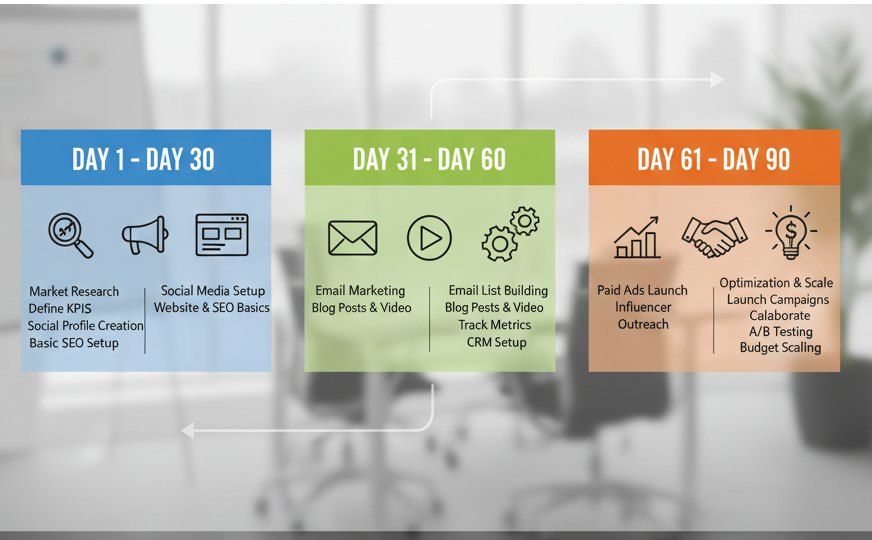
Digital marketing strategy for startups prioritizes primarily fast customer discovery, channel experimentation at low costs, and quantifiable experimentation. A 90-day plan, which justifies one channel, CPA measurement, and LTV measurement, can be used as a starting point, followed by scaling the winning channel using content, paid ads, and CRM automation.
This saves wasted budget, and it also saves time on product-market fit cycles through concentrating the resources on the established channels.
Quick Checklist: What This Page Gives You
Downloadable Resources:
- 90-day sprint schedule, weekly activities, and milestones.
- SaaS, e-commerce and local business channel decision tree.
- 3 sample ad creative templates with copy structures that are proven to work.
- KPI budget allocation calculator dashboard template.
- Why and how to start, including a guide on how to start up.
These resources are useful in executing the playbook without having to start all over again.
Stage Mapping: What “Startup” Means & How Strategy Changes by Stage
Pre-Product-Market Fit
This stage is about learning, customer validation and low-cost experiments. Examples of priority measures are completion of customer interviews, landing page conversion rates, and cost per lead less than 50. The allocation of the budget must be at 70 percent on learning experiments, and 30 percent on a basic tracking setup. The schedule focuses on experimenting with messages and media and then increasing expenditure.
Early Traction
In the initial traction stage, attention is paid to scalable channels, optimization of conversion, and repeatable systems. The priority criteria are CAC less than 3x LTV, a month-by-month growth rate of more than 20 per cent, and channel ROI positive. Paid acquisition should receive 50 percent of the budget, then the content creation 30 percent, and optimization tools 20 percent. The schedule will be the doubling of working channels and testing 1-2 new ones.
Growth/Scale Stage
The emphasis at the growth and scale phase includes process automation, retargeting funnels and scaling paid media. Some priority measures are LTV:CAC ratio over 3:1, payback period less than 12 months and churn rate less than 5%. The allocation of the budget should focus on 60 percent of paid media, 25 percent retention and automation, and the remaining 15 percent on new channel testing. The schedule entails maximizing current channels with the growth into new markets and customers.
Customer & ICP Discovery: The Foundation
This is very important to build a foundation for a digital marketing strategy for startups. Let’s dive.
Rapid Persona & Problem Interviews
5-Question Customer Interview Script:
- What do you consider to be the most difficult thing about [your industry/problem area]?
- What do you do to solve this problem today?
- What is the most irritating thing about the existing solution?
- What, in your opinion, would be a magic wand solution?
- What price would you pay to resolve this dilemma to the end?
You can conduct 20-30 interviews in your first two weeks to determine patterns and pain points.
Micro-Experiments to Validate Demand
Produce a simple landing page outlining your solution and an email sign-up form. Test messaging resonance by running a minimum of $100-500 Google or Facebook ads.
Monitor the cost per email signup and non-converting survey visitors. This authenticates demand before the establishment of complicated products or campaigns.
Essential Analytics to Install
Required Tracking Setup:
The tracking requirements are: Google Analytics 4 with enhanced ecommerce and conversion goals, Facebook Pixel to implement retargeting and conversion tracking, basic CRM (HubSpot, Pipedrive) to monitor leads through the sales funnel, and call tracking numbers (phone calls may provide important conversions).
These tools need to be installed prior to any paid campaigns to prevent any gaps in data.
Channel Decision Tree: Pick 1 Primary + 1 Secondary Channel
SaaS Businesses
With SaaS businesses, the main strategy is content marketing with LinkedIn Ads as a B2B strategy and the second strategy involves SEO of product keywords and product-led content like free tools and calculators. The allocation of the budget should be 60 per cent content and LinkedIn activity and 40 per cent SEO and organic tools.
E-commerce Businesses
The main strategy of the e-commerce business should be paid social media, such as Meta and TikTok, where they can use product discovery facilities with visual content, whereas the latter should focus on the secondary strategy, namely on product page SEO and Google Shopping campaigns. Budget allocation must allocate 70 per cent of paid social and shopping activities and 30 per cent of SEO content.
Local/Service Businesses
Google Business Profile optimization and local SEO need to be considered the main strategy of local and service-based businesses, whereas the secondary suggestion is Google Ads and service-keywords search and reputation management. The budget break should be 50-50 local SEO and 50-50 Google Ads campaigns.
Some of the channel selection principles are to begin with channels that your customers are already on, select channels that fit your content creation capacity and set the budget limit to at least $1,000 per month on paid channels to get meaningful data.
90-Day Tactical Plan: Week by Week
Weeks 1-2: Setup Phase
Tasks in this step involve the installation of analytics, building of a base landing page, installation of CRM, and interviewing of customers. The owner of the company should be the founder and a technical team member. Examples of target metrics are to engage in 20 or more customer interviews, have the landing page live and tracking installed.
Weeks 3-6: Test Phase
Tasks will involve the opening of a single paid channel test, 5 pieces of organic content, and initial CAC. The owner ought to be a marketer or founder. The target metrics will be to create 100 or more leads, CAC, and determine which content works the best.
Weeks 7-12: Optimize & Scale Phase
Tasks at this stage involve doubling the budget on the channel that has won, developing email nurture sequences, and developing retargeting campaigns. The owner will need to be a growth marketer and a designer. Target measures are to improve CAC by 25 percent, to have an email sequence to convert at 10 percent or more and retain the ROI of retargeting.
Measure performance weekly and change tactics according to what works versus the assumption of the plan.
Creative & Content: What to Make for Each Funnel Stage
Optimising TOFU, MOFU, and BOFU is essential to drive growth. Let’s discuss how you can strategise for each marketing funnel.
TOFU (Top of Funnel)
Content Types: Short explanatory video, problem-oriented blog posts, industry trend analysis.
Example Headlines: 5 Signs You Need [Your Solution], The Hidden Cost of [Problem]
Distribution: PR outreach, social media, and blog posts that are optimized with SEO.
MOFU (Middle of Funnel)
Content Types: Webinars, case studies, solution-to-solution comparison guides.
Example Headlines: [Your Solution] vs [Competitor]: Full Comparison, How [Customer] Achieved [Result]
Distribution: Email campaigns, retargeting ads, gated content downloads.
BOFU (Bottom of Funnel)
Types of content: Product demos, free trials, pricing pages that have distinct CTAs.
Sample Headings: Start Your Free Trial Today, See [Product] in Action, Get Started in 5 Minutes.
Distribution: Landing pages, sales emails, targeted advertisements to warm audiences.
Video Content Templates:
- Problem/solution: Having a problem with X? Here’s how Y solves it
- Social proof format: [Customer type] doubled [metric] with the help of [solution] by [percentage].
- How-to format: How to attain [wanted result] within [period of time]
Paid Acquisition Playbook
Small Budget PPC ($1,000-$5,000/month)
Campaign Structure: 2-3 ad groups based on the best keywords with the highest intent.
Bidding Strategy: Manual CPC beginning at 50 per cent of the proposed bid, and rising according to the performance.
Negative Keywords: Add 10-15 unrelated words a week, depending on the search query report.
Paid Social Creative Strategy
Creative Rotation: Experiment with 3-5 variations of the ad-creative in front of each audience and refresh the winning creative every month.
Audience Strategy: Use 1 percent of lookalike email subscribers to start, increase to 25 percent, depending on performance.
Budget Control: You can begin with 50/day/ad set and increase winners by 20 percent weekly.
Sample $5,000 Monthly Budget Allocation:
- Google Ads (search): $2,500 (50%)
- Facebook/Instagram Ads: $1,500 (30%)
- LinkedIn Ads (B2B): $750 (15%)
- Testing new channels: $250 (5%)
Expected Early KPIs:
- Search: CPC $2-8, conversion rate 2-5%
- Social: CPM $10-25, CTR 1-3%, conversion rate 1-3%
Organic Growth & SEO for Startups
Quick Technical SEO Checklist
Site speed: Mobile page load in less than 3 seconds (see Google PageSpeed Insights)
Mobile Optimization: Clickable buttons, readable fonts, and responsive design.
Index Coverage: Submit XML sitemap, address errors in crawl in Search Console.
Content Hub Approach
This involves making pillar pages of broad topics and you can then add cluster content of specific keywords. Examples: Main page “Marketing for Startups” and clusters of content marketing, paid ads, and email marketing.
The perfect schedule would be: Produce 2-3 content weekly, and prioritize the pain points of customers, but not the features of the product.
6-Month SEO Editorial Calendar Sample:
- Month 1-2: Content centered on problems (TOFU)
- Month 3-4: Solution comparison content (MOFU)
- Month 5-6: Implementation and case study content (BOFU)
Aim for 3-5 core keywords monthly, supported with long-tail content.
Retention & Activation: Turning Users into Repeat Customers
Onboarding Email Sequence Template
Email 1 (Day 0): Welcome and instructions on how to set up.
Email 2 (Day 2): Customer success story.
Email 3 (Day 7): How-to guide to key feature.
Email 4 (Day 14): Founder check-in.
Email 5 (Day 30): Pro secrets and upgrade package.
CRM Automation Basics
Lead Scoring: Email open points, link-clicks points, demo request points.
Summary: Follow-up email following demo, inactive user special offer.
Segmentation: Isolated flows of various customer groups or industries.
Referral Program Framework
Incentive Structure: Equal value on referrals and new customers.
Promotion: In-app notification, email signature, and after purchase follow-up.
Tracking: Easy referral codes or built-in sharing applications.
Analytics, Data & Measurement
Core Metrics by Business Type
SaaS: Monthly Recurring Revenue (MRR), Customer Acquisition Cost (CAC), Churn Rate, Lifetime Value (LTV).
E-commerce: Conversion rate, Age of Conversion, Return Customer rate, Revenue per Visitor, Average Order Value (AOV).
Local/Service: Cost per Lead, Lead-to-Customer Rate, Average Project Value, Customer Retention Rate.
Attribution Setup
First-Touch Attribution: Give credit to the initial touch (helpful with brand awareness campaigns)
Last-Touch Attribution: Give credit to the last interaction (applicable in a direct response campaign)
Multi-Touch Attribution: Credit all interactions (most accurate but more complex setup)
Dashboard Creation
Create weekly reports, which will consist of channel conversion rates, traffic sources, best performing content, and budget and results.
Free reporting can be achieved by using Google Analytics 4 + Google Looker Studio, or you may pay to use tools such as Mixpanel to track activities in an advanced manner.
Budgeting & Hiring: What to Outsource vs Build In-House
Budget Allocation by Revenue Stage
Pre-100K Revenue: 5-10% of revenue on marketing, do founder-led activities.
Revenue, 10-15% -$100K -50: Hire first marketing person or agency.
500K+ Revenue: 15-20% of revenue, create an internal team of specialized functions.
First Marketing Hires Priority Order:
- Growth Marketer: Campaign management, analytics, funnel optimization
- Content Writer: Blog writing, social media, and video production.
- Performance Manager: Scaling campaigns, advertisement specialist.
Agency vs. In-House Decision Matrix:
- Agency: Specialized skills (PPC, SEO), short-term projects, and testing the new channels.
- In-house: Brand messaging, communication with customers, long-term strategy.
Considerations: AI, Privacy & Trends
Generative AI for Creative Scaling
Prompt Framework Example: Write 5 Facebook advertisement headlines of [product] to [audience] with [benefit]. It should have social proof and urgency.
Quality Guardrails: You should always edit AI-generated content, fact-check claims, and be consistent with brand voice.
Privacy & First-Party Data
Cookie-Free Planning: Create email lists, employ customer surveys, server-side tracking
Consent Management: Could have clear privacy policies, simple opt-outs, and transparent data.
Short-Form Video & Community Growth
TikTok, Instagram Reels and YouTube Shorts have the greatest engagement. Concentrate on customer solution educational content that takes less than 15-60 seconds.
Create a community around your type of clients or industry on Discord, in Slack, or Facebook Groups.
Frequently Asked Questions
What is the first thing a startup should do for digital marketing?
Interview 20+ customers to learn about their problems, existing solutions and willingness to spend. All marketing decisions are made on this basis.
How do I choose the best channel for my startup?
Enter where your customers are spending their time. LinkedIn and content marketing tend to be effective in B2B businesses, whereas social media and search advertisements work well in B2C businesses.
How much should a startup spend on marketing per month?
Set up 5-10 percent of revenue with startups at the beginning, and progress to 15-20 percent as you grow. At least $1000/month is required to make any material paid advertising.
What metrics show whether a channel is working?
Monitor Customer Acquisition Cost (CAC) and Lifetime Value (LTV). With the payback period of less than 12 months, a healthy business possesses an LTV at least 3x higher than CAC.
How fast should I expect results from SEO vs paid ads?
Leads can be acquired in a few days through paid ads, but they need to be continued. SEO can require 3-6 months before it will yield any results, but it has long-term, cheaper traffic.
When should I hire my first marketing person?
You can hire when you are spending at least $5,000 every month on marketing or when marketing activities consume over 20 hours each week of founder time.
What’s the biggest mistake startups make with digital marketing?
Attempting to be omnipresent rather than becoming a master in one medium. Vitality is better than discontinuity when a startup has low resources.
How do I know if my landing page is effective?
When it is targeting a cold traffic conversion rate of 2-5 percent, warm traffic of 10-20 percent. Experiment with various headlines, offers, and page designs to enhance performance.
Should I focus on brand awareness or direct response marketing?
Startups must focus on direct response marketing, which will lead to direct leads and sales. Achieve brand awareness once product-market fit has been achieved.
What’s the best way to get started if I have no marketing experience?
Begin with customer interviews and a single channel, such as Google Ads or content marketing. In case you require professional advice on strategy and implementation, it would be a good idea to hire professional consultants who specialize in the development of startups.
Conclusion
This 90-day playbook is a systematic guide of digital marketing strategy for startups, which focuses on learning, testing, and scaling proven channels. Concentrating the efforts on a single channel, rigorously measuring the results, and multiplying what is working and reducing what is not performing well.
The trick is to go fast and be disciplined – go fast to experiment and be disciplined when it comes to measurement and optimization. It is important to remember that marketing is not only about bringing customers but also creating long-term systems that can expand with your business in the long run.
Ready to implement this playbook? You can start your journey with Eyal Dror Marketing.

Leave a Comment